Showing posts with label Ramen/Packaged Noodles. Show all posts

Thursday, August 27, 2015

Paldo Korean Noodle U-Dong Flavor

Made By:  Paldo Co. Ltd. [Korea]
Preparation:  Stovetop & Range
545 calories (2284kJ) per package

Sold online at AsianFoodGrocer

Our next selection from the latest Ramen Box is this Korean take on a Japanese Udon soup.  I have to admit, I have mixed feelings about trying this one:  I love the traditional Japanese mentsuyu flavor as in Nong Shim's Japanese-Style Udon, Maruchan's Akai Kitsune Udon/Midori no Tanuki Tensoba, and others.  However, I've complained quite recently about the apparent Korean penchant for dousing things in chilies until they drown the other flavors.  The Ramen Box pamphlet does say this one is "Mild," though, so I will be cautiously optimistic--even though that cartoon chef is back, and even brought a strange little sidekick with him this time.

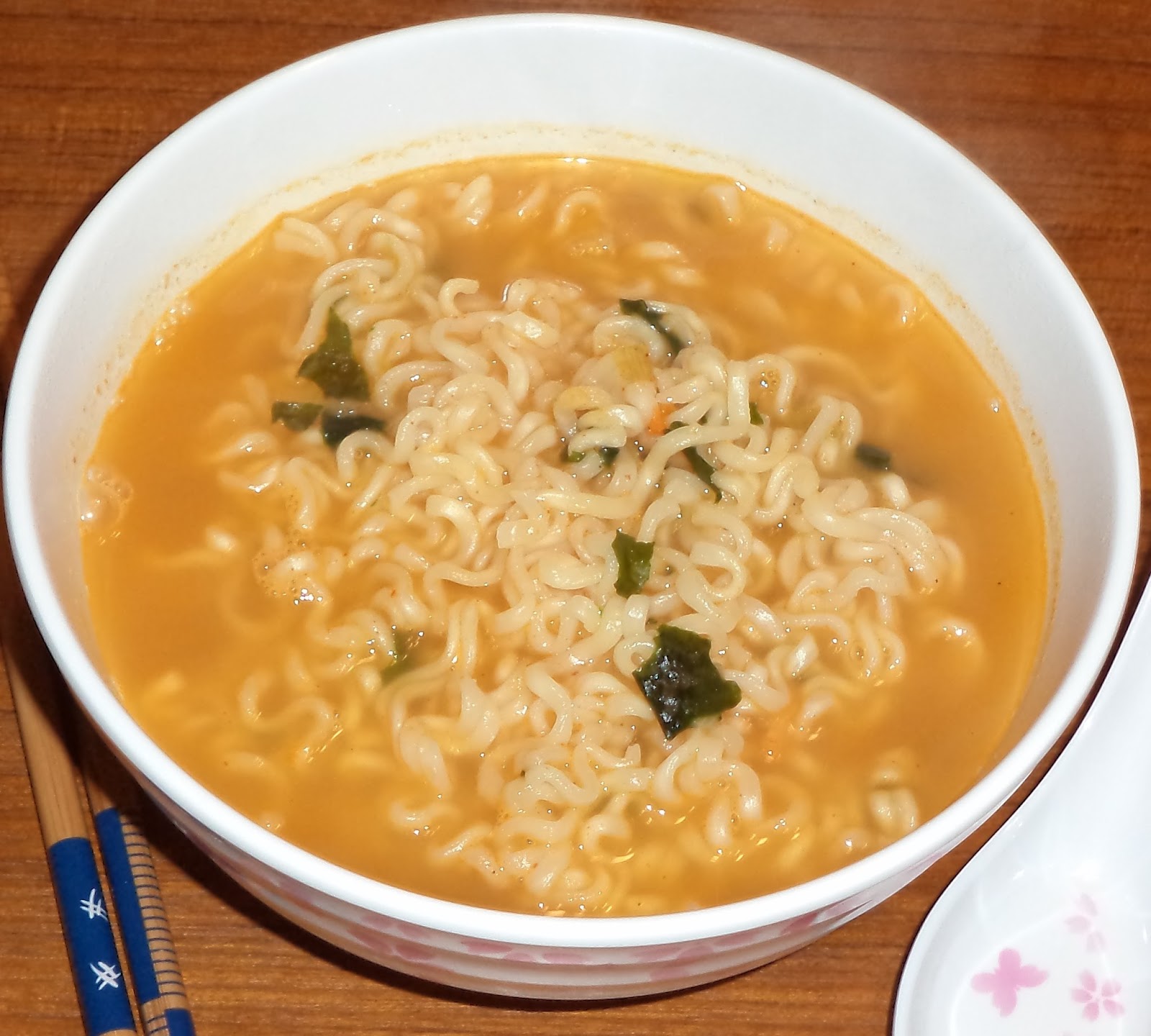
Inside the package, we find a packet of powdered Soup Base, a packet of "Frying Soup Base" which appears to be our dried veggie mix along with some little rice crackers, and a block of thick round noodles.  Preparation is standard for Korean noodles:  We bring 550cc of water to a boil, add the contents of the packets to the water, and then simmer the noodles in the broth for 4 minutes.  Just that easy, it is ready to serve!  I do notice the relative lack of angry red color in the broth, which helps me maintain my optimism.

And my optimism is rewarded; these are pretty good!  The broth does have (as advertised) a mild chili heat, but it doesn't overpower the broth, which has a nice light soy-mirin-seafood flavor.  It does seem like a lighter-flavored version of the mentsuyu, more along the lines of the Okinawa Soba we just had than some of the others mentioned above.  While the noodles can't really compare to fresh-packed udon, they do stay nicely firm and have a good flavor.  Even toward the end of the bowl, although the chili heat did build a little, it was at a nice level compared to the rest of the flavors in the bowl.
I would definitely have this one again! :D

(I still don't trust that little chef mascot, though.  In the immortal words of a former US president: "Fool me once, shame on — shame on you. Fool me — you can't get fooled again.")

Sunday, August 16, 2015

Myojo Okinawa Soba

Made By:  Myojo Foods Co. Ltd.  [Japan]
Preparation:  Saucepan & Range
400 calories per package

Available online via Amazon

Today for lunch, my wife and I are having our first noodle from the July Ramen Box!  Naturally, I gravitate straight toward the Japanese ones first, and pull out the Okinawa Soba.  I'm looking forward to them!

The package has fairly simple contents:  We have the block of wide-cut  pale noodles, a packet of a soup base, and a much smaller packet of chili powder.  We are supposed to boil 500cc of water (about 2 cups), add the noodles and cook for 3 minutes, then stir in the soup base and transfer to our bowls.  Unlike most other noodles that include a chili powder component, this one is meant to be used as garnish; it is not pure chili powder but is a version of Japanese shichimi togarashi [seven-flavor chili powder] which is milder and includes things like orange zest, sesame seeds, and seaweed flakes.  So, we dust the top of our noodles with our pepper garnish for color, and we are ready to serve!

I have to say, I really like this one!  The flavor definitely reminds me of the Japanese 'mentsuyu' flavor as in the Midori no Tanuki Tensoba or Japanese-Style Udon noodles, although it seems a bit lighter and cleaner in flavor.  I think the broth might be more anchovy based and a little less of the seaweed-and-smoked-fish 'usual' dashi flavor, and based on the color, there is definitely less of the soy sauce element.

Despite the name, the noodles are not really soba noodles, but are actually closer to an udon noodle; they are a bit slippery, soft yet not soggy, and have a light and clean flavor that pairs with the broth well.  The fact that they are based on udon and not soba may or may not be surprising, depending on whether or not you knew that "real" Okinawa Soba was made with udon-like noodles, or whether you had to find this out on Wikipedia afterwards.

While I think I still prefer the deeper flavor and the 'true' soba noodles from a Tensoba, this one is quite nice and I would definitely enjoy having more of these!  The "serving suggestion" picture on the front shows additions of braised pork belly, green onion, pickled ginger, and something that looks like mushroom but might be fishcake slices; that seems like it could be fun excuse to buy more of these.  :D

Thursday, August 6, 2015

Ottogi Sesame Flavor Ramen

Made By:  Ottogi Ramyun Co. Ltd. [Korea]
Preparation:  Saucepan & Range
490 calories per package

Available online via Amazon

For dinner tonight, we had the last selection of the instant noodles from the June Ramen Box!  My sweetie recently told me (while we were having the Sapporo Ichiban Shio Ramen that included the sesame seed topping) that she enjoys the flavor of sesame, so I am hoping this will be a hit with the entire Ramen Butterfly household.  The back of the package promises that the included Egg Block will also deliver "the rich flavor of roasted sesame," so that sounds promising.

The noodle block is a brighter yellow color than usual, and there are three included seasoning packets:  There is the dry soup base packet, the aforementioned "Egg Block", and a small packet of bright orange sesame oil.  We bring 500cc of water to a boil, then we add the soup base, egg block, and noodles and cook for four minutes.  After transferring to a bowl, we add the small amount of sesame oil and stir.  We also notice that the square Egg Block seems to have completely disappeared, so apparently instead of being a Block, it was supposed to disperse and become part of the broth.  In any case, the noodles are ready to serve!

I have to say, I am starting to get bored with the oppressive spice level of most Korean ramyuns.  It's not that I can't handle spicy food, either; I mean 'oppressive' in the sense that all the other flavors which are supposed to be present get oppressed by the large amount of chili heat.

This ramen is unfortunately a prime example:  The package doesn't even mention anything about being spicy, and it promises "rich flavor of roasted sesame."  The Ramen Box pamphlet does mention the "spicy level" is Medium, but also reassures us that this "offers a balanced taste of nuttiness and spiciness" and that the "addition of the egg block adds a savory taste to the broth."  What do we have instead?  Yet another slight variation of Shin Ramyun.  It's a shame, because the tiny hints of the subflavors that I can pick up seem like they could have been interesting, if they weren't too busy being oppressed.
My wife was even less impressed by the level of oppression, and added some American cheese to tone down the heat.  Unfortunately this didn't do anything to liberate the alleged sesame and egg undertones, and instead just turned it into some mediocre nacho cheese soup.

For the record, the noodles have a firm and slightly slippery texture, and remind me of the 'udon' style noodles from Neoguri et al.  However, I'm just adding that to the list of ways this could have been interesting but chose not to be.  I don't imagine I'll be buying this one. :\

Sunday, July 26, 2015

Sapporo Ichiban Shio Ramen

Made By:  Sanyo Foods of America [USA]
Preparation:  Saucepan & Range
480 calories per package

Available online via Amazon

This morning, we decided it was high time we had some ramen noodles again!  This is the second product from the June Ramen Box, and even though I expressed a little bit of disappointment that a "domestic" noodle would make its way into the Box, it does seem like it could be a 'breakfast noodle' kind of thing.  We'll give it a chance.

Inside the package is a block of fairly standard looking instant ramen, a 'soup base' packet, and also an included packet of sesame seeds for garnish.  Preparation is standard for 'domestic' packet noodles; we boil 2 cups (or 500cc) of water, boil the noodles for 3 minutes, then transfer to a bowl and stir in the Soup Base.  Finally, we sprinkle the sesame seed garnish on top, and our noodles are ready to serve!

The noodles have a bit firmer texture than I might have been expecting from an "American" ramen, and the broth flavor is also a pleasant surprise.  It tastes very similar to the normal domestic 'chicken' flavor ramen broth, but seems lighter and cleaner-tasting somehow.  It actually reminds me of the broth from the Paldo Kokomen we got in the previous Box, except without the jalapeƱo flavor and heat.  The light sesame flavor from the seeds was a nice touch; I think with a light clean flavor like this, adding sesame oil would be too much, but the seeds work, giving the flavor a little more dimension without any extra 'heaviness.'

I have to say, I am very pleasantly surprised!  I do accept that something doesn't have to be "Americanized" just because it's made in the USA (like many of Nong Shim's noodle products that are manufactured here but are otherwise like the Korean counterparts), and it seems that Sapporo Ichiban is following that standard, at least for this product.  Especially considering that this product should be readily available for a reasonable price, I could see us getting this again.  I'd definitely choose it over the Top Ramen and Maruchan chicken flavors, since both the noodles and the broth flavor are a big step up.  Sorry for doubting you, Ramen Box! :)

Sunday, July 5, 2015

JML Instant Noodle Artificial Stew Beef Flavor

Made By:  Jinmailang Nissin Food Co, Ltd. [China]
Required to Prepare:  Saucepan & Range
523 calories per package

Available online via Amazon

Today we are trying the first of the products from the June 2015 Ramen Box, and we decided to start with our first Chinese noodle,* this Beef Stew flavored noodle from JML (or Jin Mai Lang).  We're also kind of testing the theory that warm beverages and/or soups can actually make you feel cooler in hot weather, since we are having record-breaking heat here in the Pacific Northwest.  (If it works, I am going to have lots of tea and ramen this summer--they aren't predicting any break in the hot and dry weather any time soon.)

The package contains a block of noodles which look maybe a little narrower and lighter in color than average, along with not two, but three packets of seasonings; there is a powder soup base, a packet of dried veggies, and the third one is a seasoning oil, in solid/paste form.  We add the contents of all three packets to 500ml of water as it is coming to a boil, then we cook our noodles in the boiling broth for 3 minutes.  The aroma is quite nice; we are definitely smelling the beef base, but also a 'Chinese' spice--I am thinking some form of the five-spice mix and some ginger.  Anyway, we transfer the completed soup to our ramen bowls, and we are ready to eat!

The broth does have a rather nice flavor!  I am not sure I would completely agree with the Ramen Box brochure that this is 'not spicy', as it does have a little heat to it, but then again it is probably milder than the "Mild" Korean ramyuns that we sampled last month.  Rather, the chili flavor is part of a larger seasoning blend, which I doubt I can describe other than to say it's a pretty good instant version of Chinese beef stew like I might get from a Chinese restaurant.  The noodles are a little thinner and a bit softer than in a typical ramen, but it seems to fit here; it's not that they are 'soggy', just that they are a different type of noodle.

My wife even commented on the cabbage from the dried veggie packet; we were impressed that they seemed to actually retain some cabbage flavor, unlike what we are used to from other products' "Premium Ingredients." We were wondering to ourselves if this product might use actual dried Bok Choy cabbage instead of normal Western cabbage.  There's no way for me to know if that's true or not, but we do know we both really enjoyed this!  Next time I am off shopping for some instant noodles, I might keep an eye out for other JML products to see if they are all as enjoyable as this one. :D

*Technically, I have reviewed a couple of other products that were manufactured in China, but they were domestic brand names and made for the United States market, so to me those don't count for the 'China' category.

Sunday, June 7, 2015

Paldo Cheese Ramyun

Made By:  Paldo Co. Ltd. [Korea]
Required to Prepare:  Saucepan & Range
480 calories per package

Available online via Amazon.com

Continuing the trek through the May 2015 Ramen Box, we have this Cheese Ramyun from Paldo.  The idea of cheese ramen sounds a bit odd at first, but I don't know why it would be that much different than some other kind of cheese soup (like that awesome broccoli and cheese soup from Panera Bread).  Also, we had a good experience from the domestic Cheddar Cheese Chow Noodles, so I don't know why a 'soup' version of cheese ramen woudn't work just as well.

The contents of the package are very typical of any other Korean Ramyun, with the addition of a third packet containing "Cheese Powder."  Preparation is also very typical; we boil 550ml of water, add the dry veggies and soup base, and cook for four minutes.  The soup base itself has a reddish color not unlike the other 'hot-spicy' flavor Korean products; for the sake of science, I decide to taste the broth before adding the Cheese Powder, and it is definitely a milder version of Shin Ramyun et al--very similar to the Jin Ramen Mild that also came in this month's box.  The cheese powder seems to be the same stuff that comes in a box of macaroni and cheese, and is a bit clumpy at first, but eventually I get it stirred in, at which point the noodles are ready to serve!

The cheese is not actually the primary flavor of the broth, but (especially judging from the before/after tasting) it does change the complexion of the flavor quite a bit; there is a creaminess and tanginess that is added, which both counters a bit of the spiciness and seems to allow different sub-flavors to come out.  I should at least mention the noodles and vegetables, even though they are pretty much the same as in all the other Korean ramen products I've been having; the noodles are firm and flavorful, and the veggies are the usual green onion/carrot/cabbage blend.

I liked this one quite a bit as well!  I'm enjoying the more balanced flavors that I've been experiencing with the products that came in this Ramen Box; this one has the creaminess that I enjoy when I add an egg to a Korean 'hot' ramyun, but as a different variation with the extra tanginess that comes from the cheese--it's actually somewhere in between the egg and my sweetie's idea of adding sour cream to Shin Ramyun.  My opinion of Korean ramen has gone up after trying these products; I don't think I had realized there was this much variety.  I could see myself getting this one again as well! :)

Soup it Up:  The Ramen Box pamphlet suggests toppings of chopped green onions, egg, and additional cheese in the form of a slice of American.  We tried the extra cheese and green onions, along with some leftover roast ham. The extra cheese was a definite upgrade for me, taking it from a sort-of-creamy Korean-spice-flavored noodle to a sort-of-spicy cheese-flavored noodle, closer to my original expectations.  The extra green onion played nicely with the onion/garlic in the soup base, and the ham fit in perfectly because of course it did.  Ham and Cheese is a classic for a reason, right?

My sweetie did mention that she thought a soft egg could have gone well also--further experiments will clearly be necessary. ^_^

Tuesday, June 2, 2015

Paldo Kokomen (Spicy Chicken Flavor)

Made By:  PalDo Co. Ltd. [Korea]
Required to Prepare:  Saucepan & Range
510 calories per package

Available online via Amazon.com

Next up from the May 2015 Ramen Box is Paldo's Kokomen spicy chicken soup!  The package describes it as "Clean Spicy," and according to the Ramen Box pamphlet, this should be a Korean 'Ramyun' version of a classic chicken noodle soup.  I'm anxious to give it a try!

The package doesn't have any big surprises inside; there is a very typical block of round-style Korean ramen noodles, and the standard two packets of add-ins (one powder, one veggie flake).  Interestingly, though, the ingredients list for the vegetable packet includes chicken breast and egg flake; I don't see much visual evidence of the chicken breast although I do see some tiny yellow rectangles that are probably the eggs I was looking for.  I also can't help noticing the little caricature chef near the instructions; after a cursory search, I'm assuming this is a likeness of the Korean comedian Kyung-Kyu Lee, who (according to an Amazon reviewer) developed these noodles as part of a ramen competition show.  Anyway, normal preparation instructions for a Korean noodle:  Boil 500ml of water, add everything, and cook for 4 minutes, at which point we have...

...this bowl of appetizing-looking noodles!  The broth is somewhat clear, and I can easily see the green onion pieces as well as both green and red pepper rings.  There are also a couple of little square shavings that may or may not be the mentioned chicken breast, and some longer rectangles that are probably the egg--neither one seem to contribute anything, visually, texturally, or otherwise.
The broth has a really nice flavor; the "Clean Spicy" descriptor from the package is actually a really good description.  It is a very clean, almost western-style chicken broth, accented by a very fresh-tasting pepper flavor--more than just the heat, you can taste the green accents, it reminds me of the flavor of fresh jalapeƱo.  While the heat level is assertive, it is definitely not overpowering, and interestingly, the heat doesn't seem to 'build' as I eat more of it.  The noodles are typical and average for Korean noodles, which is to say there is definitely nothing wrong with them; they are pleasantly firm and pick up the flavor of the soup well.

I have to say, this may be my new favorite Korean-style noodle of all time (sorry, 'Black'); I enjoy how the heat in these are a fresher, brighter flavor than simply adding a big scoop of chili powder, and how it manages to complement rather than overpower the lighter, more delicate flavors in the soup.  I could be wrong, but I am even thinking these could be a great "under-the-weather" choice--it has all the 'comfort food' quality of old-fashioned chicken soup, along with some crisp, clean pepper heat to help open up the sinuses.

Not that I would wait until I was sick to have this again; I will definitely be buying more of these.  :D

Monday, June 1, 2015

Ottogi Jin Ramen (Mild)

Made By:  Ottogi Ramyon Co. Ltd. [Korea]
Required to Prepare:  Saucepan & Range
500 calories per package

Available online through Amazon.com

Tonight I am reviewing the first of the noodles from my May Ramen Box; I decided to start with the mild one of the three, Ottogi's Mild Jin Ramen.  I noticed while looking up the Amazon link that there is also a hot version of this, so Jin Ramen is probably their trademark for the traditional-flavor Korean ramyun, like Shin Ramyun for Nong Shim.

Inside the package is the typical two packets of powder soup base and dry veggies, and a block of noodles which are the slightly thicker and rounder variety; they remind me a bit of the "udon style" noodles from Neoguri or like Samyang's dried udon.  We are actually supposed to put the vegetable flakes in the water at the beginning, before we bring it to a boil, which seems like a good idea to give them more time to rehydrate.  The vegetable packet has a more interesting mix than in a lot of other noodles; in addition to the typical green onion and cabbage, there are carrots, some wakame seaweed, dried mushrooms, and even some 'beeflike' TVP bits.  Once the 550ml of water comes to a boil, we add the soup base and noodles and cook for four minutes, then transfer to a bowl and serve!

This might be mild for a Korean Ramyun, but be warned--it is still pretty spicy compared to even the "spicy" varieties of American ramen.  That said, I think it is basically the same flavor profile as in Shin Ramyun and similar "hot-spicy" flavored ramyuns.  Since the spice level is toned down from those a little, though, I find that I taste the other layers of the flavor better in this soup; I am picking up the beef-onion base over the chili heat, which is nice.  The extra veggies like the seaweed and mushroom bits are nice as well.  The noodles have a very pleasing firm texture and a nice light flavor to them, which pairs well with the broth.

I definitely think I prefer the lighter spice in this one over the regular Shin Ramyun, I think the flavor is better balanced overall.  I'm not as sure I would place it above Shin Ramyun Black, but that might not be a fair comparison as Black is a 'premium' product that would cost more.  I'll certainly enjoy having the other package that came in the box, at least, and I could see myself buying more--as Korean ramyuns go, I rather liked this one. :)

Friday, May 15, 2015

Myojo Chukazanmai Soy Sauce Flavor

Made By:  Myojo Foods Co. [Japan]
Required to Prepare:  Water, Saucepan & Range
370 calories per package

Available online at Amazon.com

I know this blog has been woefully neglected of late, but I am still around... and more importantly to the story, my wife and I have been on a bit of a ramen kick recently.  We started by having some of my (already reviewed) favorites together, but it is time to start reviewing again!  I'm re-starting things with a very traditional product from Myojo, their Chukazanmai soy sauce (shoyu) ramen.

The package contains two soup base packets, one powdered and one liquid, and a very interesting block of dried noodles--they are not 'puffed' the way almost all instant ramen is at all; they quite hard and dense, and are much more like a dry pasta, like wavy spaghetti.  The liquid seasoning packet has concentrated soy sauce and sesame-flavored oil, and the powdered base seems to be, for want of a better description, a typical "oriental flavor" soup base.
We boil 600ml (about 2-1/2 cups) of water, then add the noodles and cook for 4 minutes.  The soup bases get mixed in at the end, either before or after we transfer the soup to our bowl, and with a quick stir we are ready to have some ramen!

[Note:  the delicious oils on top of the soup caught the
camera flash in an odd way, it didn't look this weird in person.
This does show how much rich flavoring you get though!]
Well, almost ready.  It feels a bit like there is something missing, and there is--I've skipped a step in the instructions.  See, this is actually a very respectable rendition of 'real' shoyu ramen soup; the non-puffed noodles are firmer and more like fresh, and the broth has that rich sesame and soy sauce flavor.  However, a 'real' shoyu ramen would never get caught being served naked like this, which is why the last step in the instructions is:  "3.  Try adding meat, or vegetable as desired."  To start, I think the 'serving suggestion' from the front of the package, which depicts some braised pork belly along with radishes, greens, and peppers, would be delicious, but really I think it would be a fine way to use whatever meaty leftovers you had around.  Extra rotisserie chicken, roast beef, kamaboko and 6-minute eggs all sound like good things to build a bowl of ramen around.

I actually could see eating it on its own for something simple and comforting if I were under the weather, but I can definitely see that it is meant as a base for a meal soup of your own design, and I think I may try to keep a couple of packs around for just that purpose. :)

Friday, February 15, 2013

Indomie Onion Chicken Flavour Instant Noodles

Made By:  Indofood [Indonesia]
Required to Prepare:  400ml water, saucepan & range
340 calories per serving

For today's lunch, I'm reviewing an Onion Chicken flavour ramen soup from Indomie, who is probably better known for their Mi Goreng line of non-soup noodles but who also produces a decent variety of instant noodle soups--this one sounds like it should be a nice, mild, savory flavor.  On with the review!

Inside the packet we find a block of golden ramen-style noodles, along with a pack of seasoning oil and a foil double-pack containing soup base on one side and a decent portion of chili powder on the other.  To prepare, we boil our 400ml (or 1-3/4 cups) of water, and add the noodles and cook for three minutes.  Meanwhile, we are supposed to go ahead and put the contents of the flavoring packets into our bowl, and stir them up into a paste.  When I open the soup base, I notice a celery-like aroma, and the seasoning oil has a scent not unlike french-fried onions.  Anyway, once the noodles are cooked, we pour them over our seasoning paste, stir things up, and serve!

The flavor of the broth is a bit less oniony than I had expected; it seems very much like a western-style chicken broth.  The noodles have a decent texture, and interestingly, while eating the noodles I do notice a taste of the fried-onion flavor from the seasoning oil--the noodles must be picking up the oil as I lift them out of the broth, and it gave them a certain complexity that I appreciated and enjoyed.  I didn't notice a lot of spice while I was eating, but once the bowl was finished I did seem to have a small chili-heat afterglow going on.

While overall I'm not sure the flavor of these is that much different than just a plain domestic-brand chicken flavored ramen, the price is really not that much different either, and for the difference I appreciated the extra complexity and intensity of flavor that these had.  Even though they're basically "just" a chicken flavor, for some reason I'm looking forward to having them again.  :)

Saturday, February 9, 2013

MAMA Artificial Pa-Lo Duck Flavour Oriental Style Instant Noodles

Made By:  Thai President Foods, Ltd. [Thailand]
Required to Prepare:  12 oz. boiling water
240 calories per package

I wanted a small serving of noodles this morning as a pre-brunch snack, which is the perfect occasion to try one of these 2-ounce size Thai noodles.  I chose MAMA's Pa-Lo Duck flavor, so I can compare it to the "non-fried" duck flavor noodles I had a while back.  A cursory Google search seems to suggest that "Pa-Lo" is simply another word (the Thai word, perhaps?) for "five-spice", so I'm imagining the flavor will be at least similar.  I told you I was going to try to find the same flavor with the good noodles!

The package contains our lovely MAMA dark seasoned noodles, a packet of thick light-colored garlic-scented oil, and a double foil packet that has our soup base and the obligatory chili powder.  We add all the ingredients into a bowl, add 1-1/2 cups of boiling water, and cover and let stand for three minutes.  After a quick stir, we're ready to eat!

The noodles are definitely way better than the "non-fried" ones, with the nice firm texture that I am used to.  They might be a little less flavorful than I remember, but maybe it's not fair to compare these to noodles that have soaked in Tom Yum broth.  The broth is a bit spicier than I was expecting; I did rate the other ones at about a 3-star level, but these are probably more like a four.  Perhaps due to this, the five-spice flavor seems a little bit subtle, but it is there, along with a nice rich duck-broth base.

Overall, these were quite enjoyable, though they seemed a bit overly spicy for a morning snack.  Of course, I could probably do something about that by leaving out some or all of the chili powder, which I might actually do in the future--while I don't usually mind spice heat, it seemed a little out of place in this one.  While I still prefer the flavor of the Tom Yum varieties, I could see wanting this one again.  Oh, and of course it practically goes without saying that for only twenty extra calories per package, this one is just strictly better than the "non-fried" version. :)

Tuesday, January 8, 2013

Samyang Japanese Seafood Flavor Udon

Made By:  Samyang Foods Co., Ltd. [Korea]
Required to Prepare:  550cc water, Saucepan & range
500 calories per package

A happy 2013 to everyone!  This year my sweetie and I have resolved to eat healthier, and this means I plan to be eating (and reviewing!) more instant noodles.  That might sound strange to some, but trust me, compared to eating lunch at fast food restaurants, ramen is a veritable health food.  To help get on board the wagon, yesterday I finally made it down to Uwajimaya in Bellevue to stock up on noodles and asian foodstuffs.

Rather than stand about wracked with indecision from an overabundance of choices, for lunch today I just plucked a packet off the top of the new-and-improved Noodle Stash and ended up with these Japanese Seafood udon noodles from Samyang.  The package informs me that "This is the oriental style Udon Which is soft noodles and clear soup taste in addition to the fresh raw-materials."  I find it amusing and slightly ironic, since these are a dried product instead of a fresh, soft-packed udon.

Anyway, inside the package, we find our large square brick of raw-materials thick noodles, a packet of soup base, and one labeled 'flake.'  We bring 550cc (or 2-1/3 cups) of water to a boil in our saucepan, add the contents of the packets and the noodles, and cook for 5 minutes.  Transfer our noodles to a bowl, and it is time to have lunch!

The broth is actually a bit more bland than I was expecting; rather than the usual dashi-and-shoyu Japanese-style broth that I am used to from some of the other udon products, this one seemed more along the lines of the generic "Oriental" flavor that you might find in a Top Ramen.  At first I thought maybe it was a straight dashi broth, but I made a small cup of HonDashi instant broth to compare, and this product seemed to be lacking both the smokiness and the seaweed undertone.  "Clear soup taste," indeed.

The noodles, on the other hand, were a pleasant surprise; I was expecting basically a Neoguri or Chapagetti-style thick puffed noodle, but these were the best rendition of the flavor and texture of fresh udon that I've had so far from a dry product.  They're still not quite the same as fresh raw-materials udon, but I enjoyed the noodles.  Overall, while these weren't bad by any means, the broth is forgettable enough that I doubt they will be a repurchase.  :|

Tuesday, October 16, 2012

MAMA Oriental Style Instant Noodles Artificial Tom Yum Pork Flavor

 Made By:  Thai President Foods, Ltd. [Thailand]
Required to Prepare:  Hot water (10oz)
270 calories per package

(Available online from VeryAsia.com)

Today I chose another noodle from MAMA, just so I can remind myself how good their 'regular' noodles are compared to those 'non-fried' ones I had last time.  I've already reviewed two of these Tom Yum flavors--Shrimp, and Creamy Shrimp--so I'll also see how much different a Tom Yum Pork can possibly be from a Tom Yum Shrimp.

Inside the package is our lovely golden-brown block of noodles, along with three seasoning packets.  The pink one is the powdered Tom Yum soup base, but unlike the shrimp varieties, there is no chili powder packet--instead, the yellow foil pack has mostly sesame seeds in it, and rather than a bright red chili oil packet, the orange oil packet has a thick oil infused with minced garlic.  Preparation is the same, at least:  We place all the ingredients into a bowl, add 1-1/4 cups of boiling water, and cover and wait three minutes.  Then we stir it up and serve!

While the Tom Yum hot-and-sour flavor is still the primary flavor of the broth, the sub-flavors are indeed quite a bit different.  The garlic sub-flavor is subtle but blends with the Tom Yum flavor well.  Despite the absence of either chili oil or chili powder packets, it is not mild in the least, although it's possibly a little less aggressive than the shrimp versions.  I think it might be my favorite version of Tom Yum soup I've tried so far!  As far as the noodles themselves go, I'll just say that MAMA's firm, light, delicious oriental-style noodles are still my favorite.  I'm definitely going to be keeping this one in stock from now on!  :D

Saturday, October 13, 2012

MAMA Ramen Artificial Duck Flavor

Made By:  Thai President Foods, Ltd.
Required to Prepare:  Saucepan & Range, 1-1/2c water
220 calories per package


The Ramen Butterfly is back by popular demand!  Whoa, has it really been over four months since I did one of these?  I guess time flies when you get sidetracked, sometimes.  Thanks to the supportive commenter who reminded me I need to eat some noodles!

So, today I had these Artificial Duck Flavor "Oriental Non-Fried Instant Noodles" from MAMA; I figured the Thailand-style small serving was good for an afternoon snack.  I like most of MAMA's products quite a bit, but I'm also not sure what to expect from a non-fried noodle, so we'll just have to see what these are like!

Inside the package is a loosely-formed block of semi-translucent noodles, along with three flavor packets; we have a seasoning powder and a seasoning oil, along with the usual (for Thai noodles) small packet of optional chili powder.  We are supposed to bring 1-1/2 cups of water to a boil, add the noodles and cook for 3-4 minutes, and then stir in the seasoning powder--naturally, I add the entire packet of chili powder too.  The instructions tell us to put the seasoning "oil" (which is more of a paste) in the bowl and add the noodles on top, which I do, although why it matters how you add it to the soup is beyond me.  Give everything a stir, and we are ready to serve!

The main aroma I detect is of five-spice seasoning, not duck.  I wonder if that is a traditional seasoning for duck in Thailand?  In any case, the broth has a nice flavor of both duck and five-spice.  With the entire chili packet, I'd rate the heat level at around a 3/5, and of course that can be tailored to your preference by adding less or none of the packet.  The noodle texture is very different from MAMA's other noodle products; instead of being dark, firm, and flavorful, these 'non-fried' noodles are pale, quite soft, and don't seem to have much flavor of their own aside from what they pick up from the soup--a lot like the noodles in a domestic Top Ramen.  I wouldn't call them bad, exactly, but I do rather prefer the normal MAMA noodles.  Would I have them again?  Honestly, probably not, when I could probably find the same flavor with the nicer noodles for a similar calorie count.  I did like the flavor though. :|

Monday, June 11, 2012

Nissin Demae Ramen Five Spices Artificial Beef Flavor

Made By:  Nissin Foods (Hong Kong)
Required to prepare:  Saucepan & Range, 500cc water
460 calories per package

(Available online through Amazon.com)

One thing about making the transition from unemployed to self-employed is that there are more demands on time--just because there is a lot of work to do for the business doesn't mean there's suddenly less housework to make up for it.  So where does the Ramen Butterfly turn when she wants a quick and easy lunch?  Instant noodles to the rescue!

Today's rescuer is this Five Spices Artificial Beef Flavor ramen from Nissin of Hong Kong.  For those unfamiliar, the five spices in Chinese five-spice can actually vary a little, but the main flavor note is always a cinnamon-clove-anise blend of some sort.  (It's actually not that far removed from an American pumpkin-pie spice blend.)  It's an interesting flavor, but one that can be overpowering if used irresponsibly, so we'll see how it translates into a ramen flavor.

Inside the package we find a very typical block of ramen, and two seasoning packets--a soup base, and a small amount of seasoning oil (which has kind of a french-onion thing going on).  We boil our 500cc [2-1/4 cups] of water, add the noodles and cook for three minutes, then add the flavorings and serve!

The noodles have a nicer texture than I had remembered Nissin Demae noodles being; they actually have a very pleasant mouthfeel.  The broth is a very nice balance between a beef broth and the five spice flavor; the five-spice is definitely noticeable but it isn't too strong.  Being a Nissin Demae product, there are of course no vegetables or faux-meat bits to review, but those can be a distraction as easily as they can be a feature anyway. I would have to say that out of the three Nissin Demae products I've reviewed so far, this one is probably my favorite!  I certainly wouldn't mind having this one again. :)

Saturday, June 9, 2012

Paldo Green Tea Chlorella Noodles

Made By:  Korea Yakult Co. Ltd (Korea)
Required to Prepare:  Saucepan & Range, 550cc water
510 calories per package (?)*

(Available online through Amazon.com)

It's noodle time again!  This morning I'm going to get adventurous and try these Green Tea Chlorella noodles I picked up at Uwajimaya Bellevue last time I was there.  For the uneducated (like myself before I looked it up on Wikipedia), chlorella is a type of edible algae that was originally discovered as an inexpensive protein source and has more recently gotten a following as a "superfood."  I'm actually not that concerned about the health merits of chlorella--I'm interested to find out how it tastes when you make noodles with it!

Inside the package we find our block of green-tinted noodles, along with two packets--one with dried veggie bits, and the other with a powdered soup base that has an aroma of dashi [fish & seaweed] stock.  We bring our 550cc (around 20 oz.) of water to a boil, add our soup base packets and noodles, and cook for four minutes, and then our soup is ready to serve!

The finished soup does look a bit strange, with the green-tinged noodles in the brownish-colored broth.  Despite the unusual appearance of the noodles, their flavor is fairly unremarkable; it may be that chlorella is a bit like tofu where it doesn't have a significant flavor of its own when you cook with it.  The texture is quite nice though; the noodles are firm, just a shade softer than al dente, and not sticky or slippery.  The veggies seem content to avoid the spotlight; there are bits of kombu seaweed, some green onion, and a couple of chile-pepper rings, none of which stand out either positively or negatively.  The broth is a fairly typical Japanese-style dashi broth, which I happen to love--it's very similar to the flavor of the broth in the Nong Shim Japanese-Style Udon.  If there is a 'green tea' flavor element present, it's very subtle to the point of being totally overpowered by the dashi flavor.

In other words, despite the odd appearance, the flavor of the soup is actually quite tame, though not in a bad way.  If you enjoy Japanese-style ramen soup, I'd recommend this one as a worthy option in the category!  And who knows, that green stuff might end up being good for us. :D

*:  According to the nutrition information, there are 510 calories in half the package.  I'm convinced this is a typo, though, because the entire package is only 120 grams, and 8-1/2 calories per gram of food seems rather implausible.

Saturday, May 26, 2012

Yamachan Shoyu Ramen

Made By:  Nippon Trends Food Service (Product of USA)
Required to Prepare:  Saucepan & Range, Boiling Water
360 calories per package

While I was browsing the aisles at Uwajimaya Bellevue on my last visit, I found a section of fresh noodles in the refrigerated section, away from the extensive dry-goods instant noodle aisle.  Since they are fresh and need to be refrigerated, they obviously have a shorter shelf-life than the 'normal' dry ramen, so I just picked up one to try this time.

Inside the package there is a styrofoam tray that holds the pack of fresh noodles, and a little foil packet of liquid soup base.  To prepare, we need to boil water in both our saucepan and our teakettle; we add the noodles to the saucepan and cook for 1-1/2 minutes (or 2-1/2 minutes if frozen), and meanwhile we mix 1-1/4 cups of boiling water with the soup base in our bowl.  Once the noodles are cooked, we drain them and add them to the bowl, and the noodles are ready to serve!

The noodles have a wonderful texture, much more like "real" restaurant ramen than the dry ramen everyone is used to.  The broth tastes a bit different than I was expecting from a shoyu broth; there is a strong taste of sesame oil which really overpowers the other flavors.  Overall, the soup is kind of plain, honestly, but I don't hold that against it, because it's clearly meant as a base for you to add your own ingredients (much like restaurant ramen).  So, although I think it is just okay on its own (and I felt obligated to review it that way), I am definitely looking forward to having it again--and adding my own green onion, crab stick, boiled egg, and other nifty ingredients to make this into a really awesome bowl of "real" ramen.  :)