Made By: Paldo Co. Ltd. [Korea]
Preparation: Stovetop & Range
545 calories (2284kJ) per package
Sold online at AsianFoodGrocer
Our next selection from the latest Ramen Box is this Korean take on a Japanese Udon soup. I have to admit, I have mixed feelings about trying this one: I love the traditional Japanese mentsuyu flavor as in Nong Shim's Japanese-Style Udon, Maruchan's Akai Kitsune Udon/Midori no Tanuki Tensoba, and others. However, I've complained quite recently about the apparent Korean penchant for dousing things in chilies until they drown the other flavors. The Ramen Box pamphlet does say this one is "Mild," though, so I will be cautiously optimistic--even though that cartoon chef is back, and even brought a strange little sidekick with him this time.
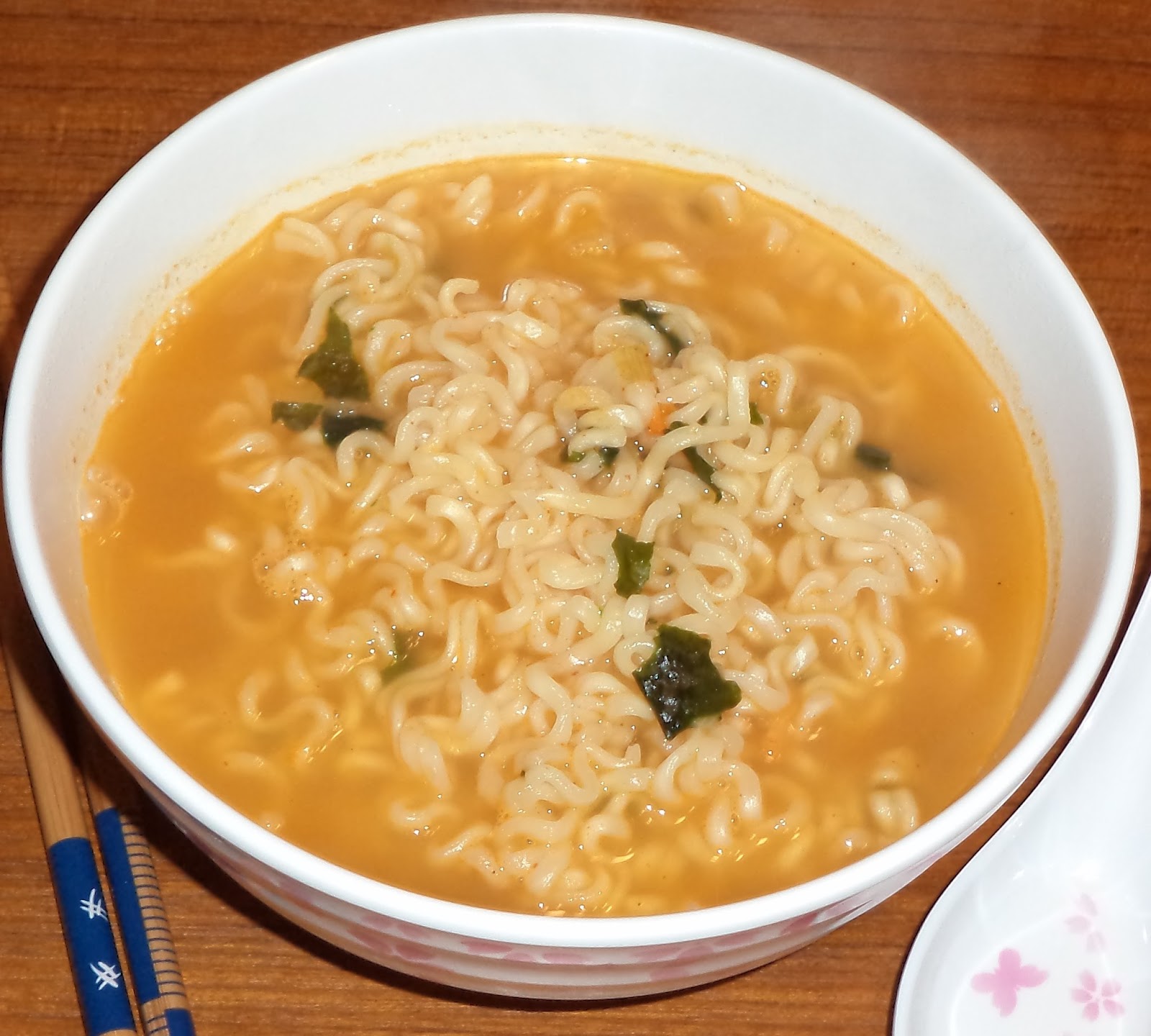
Inside the package, we find a packet of powdered Soup Base, a packet of "Frying Soup Base" which appears to be our dried veggie mix along with some little rice crackers, and a block of thick round noodles. Preparation is standard for Korean noodles: We bring 550cc of water to a boil, add the contents of the packets to the water, and then simmer the noodles in the broth for 4 minutes. Just that easy, it is ready to serve! I do notice the relative lack of angry red color in the broth, which helps me maintain my optimism.
And my optimism is rewarded; these are pretty good! The broth does have (as advertised) a mild chili heat, but it doesn't overpower the broth, which has a nice light soy-mirin-seafood flavor. It does seem like a lighter-flavored version of the mentsuyu, more along the lines of the Okinawa Soba we just had than some of the others mentioned above. While the noodles can't really compare to fresh-packed udon, they do stay nicely firm and have a good flavor. Even toward the end of the bowl, although the chili heat did build a little, it was at a nice level compared to the rest of the flavors in the bowl.
I would definitely have this one again! :D
(I still don't trust that little chef mascot, though. In the immortal words of a former US president: "Fool me once, shame on — shame on you. Fool me — you can't get fooled again.")
Showing posts with label Korea. Show all posts
Thursday, August 27, 2015
Thursday, August 6, 2015
Ottogi Sesame Flavor Ramen
Made By: Ottogi Ramyun Co. Ltd. [Korea]
Preparation: Saucepan & Range
490 calories per package
Available online via Amazon
For dinner tonight, we had the last selection of the instant noodles from the June Ramen Box! My sweetie recently told me (while we were having the Sapporo Ichiban Shio Ramen that included the sesame seed topping) that she enjoys the flavor of sesame, so I am hoping this will be a hit with the entire Ramen Butterfly household. The back of the package promises that the included Egg Block will also deliver "the rich flavor of roasted sesame," so that sounds promising.
The noodle block is a brighter yellow color than usual, and there are three included seasoning packets: There is the dry soup base packet, the aforementioned "Egg Block", and a small packet of bright orange sesame oil. We bring 500cc of water to a boil, then we add the soup base, egg block, and noodles and cook for four minutes. After transferring to a bowl, we add the small amount of sesame oil and stir. We also notice that the square Egg Block seems to have completely disappeared, so apparently instead of being a Block, it was supposed to disperse and become part of the broth. In any case, the noodles are ready to serve!
I have to say, I am starting to get bored with the oppressive spice level of most Korean ramyuns. It's not that I can't handle spicy food, either; I mean 'oppressive' in the sense that all the other flavors which are supposed to be present get oppressed by the large amount of chili heat.
This ramen is unfortunately a prime example: The package doesn't even mention anything about being spicy, and it promises "rich flavor of roasted sesame." The Ramen Box pamphlet does mention the "spicy level" is Medium, but also reassures us that this "offers a balanced taste of nuttiness and spiciness" and that the "addition of the egg block adds a savory taste to the broth." What do we have instead? Yet another slight variation of Shin Ramyun. It's a shame, because the tiny hints of the subflavors that I can pick up seem like they could have been interesting, if they weren't too busy being oppressed.
My wife was even less impressed by the level of oppression, and added some American cheese to tone down the heat. Unfortunately this didn't do anything to liberate the alleged sesame and egg undertones, and instead just turned it into some mediocre nacho cheese soup.
For the record, the noodles have a firm and slightly slippery texture, and remind me of the 'udon' style noodles from Neoguri et al. However, I'm just adding that to the list of ways this could have been interesting but chose not to be. I don't imagine I'll be buying this one. :\
Preparation: Saucepan & Range
490 calories per package
Available online via Amazon
For dinner tonight, we had the last selection of the instant noodles from the June Ramen Box! My sweetie recently told me (while we were having the Sapporo Ichiban Shio Ramen that included the sesame seed topping) that she enjoys the flavor of sesame, so I am hoping this will be a hit with the entire Ramen Butterfly household. The back of the package promises that the included Egg Block will also deliver "the rich flavor of roasted sesame," so that sounds promising.
The noodle block is a brighter yellow color than usual, and there are three included seasoning packets: There is the dry soup base packet, the aforementioned "Egg Block", and a small packet of bright orange sesame oil. We bring 500cc of water to a boil, then we add the soup base, egg block, and noodles and cook for four minutes. After transferring to a bowl, we add the small amount of sesame oil and stir. We also notice that the square Egg Block seems to have completely disappeared, so apparently instead of being a Block, it was supposed to disperse and become part of the broth. In any case, the noodles are ready to serve!
I have to say, I am starting to get bored with the oppressive spice level of most Korean ramyuns. It's not that I can't handle spicy food, either; I mean 'oppressive' in the sense that all the other flavors which are supposed to be present get oppressed by the large amount of chili heat.
This ramen is unfortunately a prime example: The package doesn't even mention anything about being spicy, and it promises "rich flavor of roasted sesame." The Ramen Box pamphlet does mention the "spicy level" is Medium, but also reassures us that this "offers a balanced taste of nuttiness and spiciness" and that the "addition of the egg block adds a savory taste to the broth." What do we have instead? Yet another slight variation of Shin Ramyun. It's a shame, because the tiny hints of the subflavors that I can pick up seem like they could have been interesting, if they weren't too busy being oppressed.
My wife was even less impressed by the level of oppression, and added some American cheese to tone down the heat. Unfortunately this didn't do anything to liberate the alleged sesame and egg undertones, and instead just turned it into some mediocre nacho cheese soup.
For the record, the noodles have a firm and slightly slippery texture, and remind me of the 'udon' style noodles from Neoguri et al. However, I'm just adding that to the list of ways this could have been interesting but chose not to be. I don't imagine I'll be buying this one. :\
Monday, June 8, 2015
Ottogi Ppushu Ppushu Noodle Snack (BBQ Flavor)
Made by: Ottogi Ramyon Co. Ltd. [Korea]
Required to Prepare:Large Wooden Mallet Nothing!
205 calories per 1/2 package
Available online via Amazon (as part of variety pack)
The final product that I received in the May 2015 Ramen Box is this "Noodle Snack" from Ottogi. Despite being--by all appearances--a package of ramen, complete with separate seasoning packet, the caped mallet boy on the package urges, "Don't boil it, Crunch it!"
Before researching this entry, I was a litle apprehensive about the idea of eating raw noodles, honestly; my mind was conjuring up an image not unlike trying to chew up raw spaghetti. But apparently, this is a thing that people like college students have been doing for years, and Ottogi has merely legitimized the practice by making it an official product line. (I'm guessing I dropped out of college too early to have learned of this practice in school like everyone else.)
Anyway, all we do is crush up the noodles into bite-size pieces (or smaller--I got a bit carried away I think), then open and pour in the seasoning pack and shake it up to spread the seasonings onto the crunchy noodles, then we eat them.
{Or rather, I eat them, because my sweetie immediately found the flavor revolting.}
The noodles were actually a pleasant surprise! Far from 'uncooked pasta' texture, they are much more like those crunchy "Chow Mein Noodles" that come in a can. (Stay in school, kids!) I rather liked the flavor; it seems like an Asian variation of the sweet barbecue flavor that most "BBQ Flavor" potato chips use; along with an overtone of sweet soy sauce, there are garlic/onion and smoked-meat notes.
In a reversal from many ramen products that list their nutrition as two servings even though they are clearly for one, this one is listed for the entire package, which turns out to be more than I would want in one sitting--I ended up saving half the package for later, so I am calling it two 205-calorie servings.
On first taste, they seemed like a novelty item that I might not buy again, but after half the package, I have to say they were starting to seem rather craveable, so depending on price, I could maybe see buying some just to have a fun snack to take to work, and I could see myself trying out the other flavors as well. :)
Required to Prepare:
205 calories per 1/2 package
Available online via Amazon (as part of variety pack)
The final product that I received in the May 2015 Ramen Box is this "Noodle Snack" from Ottogi. Despite being--by all appearances--a package of ramen, complete with separate seasoning packet, the caped mallet boy on the package urges, "Don't boil it, Crunch it!"
Before researching this entry, I was a litle apprehensive about the idea of eating raw noodles, honestly; my mind was conjuring up an image not unlike trying to chew up raw spaghetti. But apparently, this is a thing that people like college students have been doing for years, and Ottogi has merely legitimized the practice by making it an official product line. (I'm guessing I dropped out of college too early to have learned of this practice in school like everyone else.)
Anyway, all we do is crush up the noodles into bite-size pieces (or smaller--I got a bit carried away I think), then open and pour in the seasoning pack and shake it up to spread the seasonings onto the crunchy noodles, then we eat them.
{Or rather, I eat them, because my sweetie immediately found the flavor revolting.}
The noodles were actually a pleasant surprise! Far from 'uncooked pasta' texture, they are much more like those crunchy "Chow Mein Noodles" that come in a can. (Stay in school, kids!) I rather liked the flavor; it seems like an Asian variation of the sweet barbecue flavor that most "BBQ Flavor" potato chips use; along with an overtone of sweet soy sauce, there are garlic/onion and smoked-meat notes.
In a reversal from many ramen products that list their nutrition as two servings even though they are clearly for one, this one is listed for the entire package, which turns out to be more than I would want in one sitting--I ended up saving half the package for later, so I am calling it two 205-calorie servings.
On first taste, they seemed like a novelty item that I might not buy again, but after half the package, I have to say they were starting to seem rather craveable, so depending on price, I could maybe see buying some just to have a fun snack to take to work, and I could see myself trying out the other flavors as well. :)
Labels:
:),
Chips and Snacks,
Korea,
Ottogi,
The Ramen Box
Sunday, June 7, 2015
Paldo Cheese Ramyun
Made By: Paldo Co. Ltd. [Korea]
Required to Prepare: Saucepan & Range
480 calories per package
Available online via Amazon.com
Continuing the trek through the May 2015 Ramen Box, we have this Cheese Ramyun from Paldo. The idea of cheese ramen sounds a bit odd at first, but I don't know why it would be that much different than some other kind of cheese soup (like that awesome broccoli and cheese soup from Panera Bread). Also, we had a good experience from the domestic Cheddar Cheese Chow Noodles, so I don't know why a 'soup' version of cheese ramen woudn't work just as well.
The contents of the package are very typical of any other Korean Ramyun, with the addition of a third packet containing "Cheese Powder." Preparation is also very typical; we boil 550ml of water, add the dry veggies and soup base, and cook for four minutes. The soup base itself has a reddish color not unlike the other 'hot-spicy' flavor Korean products; for the sake of science, I decide to taste the broth before adding the Cheese Powder, and it is definitely a milder version of Shin Ramyun et al--very similar to the Jin Ramen Mild that also came in this month's box. The cheese powder seems to be the same stuff that comes in a box of macaroni and cheese, and is a bit clumpy at first, but eventually I get it stirred in, at which point the noodles are ready to serve!
The cheese is not actually the primary flavor of the broth, but (especially judging from the before/after tasting) it does change the complexion of the flavor quite a bit; there is a creaminess and tanginess that is added, which both counters a bit of the spiciness and seems to allow different sub-flavors to come out. I should at least mention the noodles and vegetables, even though they are pretty much the same as in all the other Korean ramen products I've been having; the noodles are firm and flavorful, and the veggies are the usual green onion/carrot/cabbage blend.
I liked this one quite a bit as well! I'm enjoying the more balanced flavors that I've been experiencing with the products that came in this Ramen Box; this one has the creaminess that I enjoy when I add an egg to a Korean 'hot' ramyun, but as a different variation with the extra tanginess that comes from the cheese--it's actually somewhere in between the egg and my sweetie's idea of adding sour cream to Shin Ramyun. My opinion of Korean ramen has gone up after trying these products; I don't think I had realized there was this much variety. I could see myself getting this one again as well! :)
Soup it Up: The Ramen Box pamphlet suggests toppings of chopped green onions, egg, and additional cheese in the form of a slice of American. We tried the extra cheese and green onions, along with some leftover roast ham. The extra cheese was a definite upgrade for me, taking it from a sort-of-creamy Korean-spice-flavored noodle to a sort-of-spicy cheese-flavored noodle, closer to my original expectations. The extra green onion played nicely with the onion/garlic in the soup base, and the ham fit in perfectly because of course it did. Ham and Cheese is a classic for a reason, right?
My sweetie did mention that she thought a soft egg could have gone well also--further experiments will clearly be necessary. ^_^
Required to Prepare: Saucepan & Range
480 calories per package
Available online via Amazon.com
Continuing the trek through the May 2015 Ramen Box, we have this Cheese Ramyun from Paldo. The idea of cheese ramen sounds a bit odd at first, but I don't know why it would be that much different than some other kind of cheese soup (like that awesome broccoli and cheese soup from Panera Bread). Also, we had a good experience from the domestic Cheddar Cheese Chow Noodles, so I don't know why a 'soup' version of cheese ramen woudn't work just as well.
The contents of the package are very typical of any other Korean Ramyun, with the addition of a third packet containing "Cheese Powder." Preparation is also very typical; we boil 550ml of water, add the dry veggies and soup base, and cook for four minutes. The soup base itself has a reddish color not unlike the other 'hot-spicy' flavor Korean products; for the sake of science, I decide to taste the broth before adding the Cheese Powder, and it is definitely a milder version of Shin Ramyun et al--very similar to the Jin Ramen Mild that also came in this month's box. The cheese powder seems to be the same stuff that comes in a box of macaroni and cheese, and is a bit clumpy at first, but eventually I get it stirred in, at which point the noodles are ready to serve!
The cheese is not actually the primary flavor of the broth, but (especially judging from the before/after tasting) it does change the complexion of the flavor quite a bit; there is a creaminess and tanginess that is added, which both counters a bit of the spiciness and seems to allow different sub-flavors to come out. I should at least mention the noodles and vegetables, even though they are pretty much the same as in all the other Korean ramen products I've been having; the noodles are firm and flavorful, and the veggies are the usual green onion/carrot/cabbage blend.
I liked this one quite a bit as well! I'm enjoying the more balanced flavors that I've been experiencing with the products that came in this Ramen Box; this one has the creaminess that I enjoy when I add an egg to a Korean 'hot' ramyun, but as a different variation with the extra tanginess that comes from the cheese--it's actually somewhere in between the egg and my sweetie's idea of adding sour cream to Shin Ramyun. My opinion of Korean ramen has gone up after trying these products; I don't think I had realized there was this much variety. I could see myself getting this one again as well! :)
Soup it Up: The Ramen Box pamphlet suggests toppings of chopped green onions, egg, and additional cheese in the form of a slice of American. We tried the extra cheese and green onions, along with some leftover roast ham. The extra cheese was a definite upgrade for me, taking it from a sort-of-creamy Korean-spice-flavored noodle to a sort-of-spicy cheese-flavored noodle, closer to my original expectations. The extra green onion played nicely with the onion/garlic in the soup base, and the ham fit in perfectly because of course it did. Ham and Cheese is a classic for a reason, right?
My sweetie did mention that she thought a soft egg could have gone well also--further experiments will clearly be necessary. ^_^
Tuesday, June 2, 2015
Paldo Kokomen (Spicy Chicken Flavor)
Made By: PalDo Co. Ltd. [Korea]
Required to Prepare: Saucepan & Range
510 calories per package
Available online via Amazon.com
Next up from the May 2015 Ramen Box is Paldo's Kokomen spicy chicken soup! The package describes it as "Clean Spicy," and according to the Ramen Box pamphlet, this should be a Korean 'Ramyun' version of a classic chicken noodle soup. I'm anxious to give it a try!
The package doesn't have any big surprises inside; there is a very typical block of round-style Korean ramen noodles, and the standard two packets of add-ins (one powder, one veggie flake). Interestingly, though, the ingredients list for the vegetable packet includes chicken breast and egg flake; I don't see much visual evidence of the chicken breast although I do see some tiny yellow rectangles that are probably the eggs I was looking for. I also can't help noticing the little caricature chef near the instructions; after a cursory search, I'm assuming this is a likeness of the Korean comedian Kyung-Kyu Lee, who (according to an Amazon reviewer) developed these noodles as part of a ramen competition show. Anyway, normal preparation instructions for a Korean noodle: Boil 500ml of water, add everything, and cook for 4 minutes, at which point we have...
...this bowl of appetizing-looking noodles! The broth is somewhat clear, and I can easily see the green onion pieces as well as both green and red pepper rings. There are also a couple of little square shavings that may or may not be the mentioned chicken breast, and some longer rectangles that are probably the egg--neither one seem to contribute anything, visually, texturally, or otherwise.
The broth has a really nice flavor; the "Clean Spicy" descriptor from the package is actually a really good description. It is a very clean, almost western-style chicken broth, accented by a very fresh-tasting pepper flavor--more than just the heat, you can taste the green accents, it reminds me of the flavor of fresh jalapeño. While the heat level is assertive, it is definitely not overpowering, and interestingly, the heat doesn't seem to 'build' as I eat more of it. The noodles are typical and average for Korean noodles, which is to say there is definitely nothing wrong with them; they are pleasantly firm and pick up the flavor of the soup well.
I have to say, this may be my new favorite Korean-style noodle of all time (sorry, 'Black'); I enjoy how the heat in these are a fresher, brighter flavor than simply adding a big scoop of chili powder, and how it manages to complement rather than overpower the lighter, more delicate flavors in the soup. I could be wrong, but I am even thinking these could be a great "under-the-weather" choice--it has all the 'comfort food' quality of old-fashioned chicken soup, along with some crisp, clean pepper heat to help open up the sinuses.
Not that I would wait until I was sick to have this again; I will definitely be buying more of these. :D
Required to Prepare: Saucepan & Range
510 calories per package
Available online via Amazon.com
Next up from the May 2015 Ramen Box is Paldo's Kokomen spicy chicken soup! The package describes it as "Clean Spicy," and according to the Ramen Box pamphlet, this should be a Korean 'Ramyun' version of a classic chicken noodle soup. I'm anxious to give it a try!
The package doesn't have any big surprises inside; there is a very typical block of round-style Korean ramen noodles, and the standard two packets of add-ins (one powder, one veggie flake). Interestingly, though, the ingredients list for the vegetable packet includes chicken breast and egg flake; I don't see much visual evidence of the chicken breast although I do see some tiny yellow rectangles that are probably the eggs I was looking for. I also can't help noticing the little caricature chef near the instructions; after a cursory search, I'm assuming this is a likeness of the Korean comedian Kyung-Kyu Lee, who (according to an Amazon reviewer) developed these noodles as part of a ramen competition show. Anyway, normal preparation instructions for a Korean noodle: Boil 500ml of water, add everything, and cook for 4 minutes, at which point we have...
...this bowl of appetizing-looking noodles! The broth is somewhat clear, and I can easily see the green onion pieces as well as both green and red pepper rings. There are also a couple of little square shavings that may or may not be the mentioned chicken breast, and some longer rectangles that are probably the egg--neither one seem to contribute anything, visually, texturally, or otherwise.
The broth has a really nice flavor; the "Clean Spicy" descriptor from the package is actually a really good description. It is a very clean, almost western-style chicken broth, accented by a very fresh-tasting pepper flavor--more than just the heat, you can taste the green accents, it reminds me of the flavor of fresh jalapeño. While the heat level is assertive, it is definitely not overpowering, and interestingly, the heat doesn't seem to 'build' as I eat more of it. The noodles are typical and average for Korean noodles, which is to say there is definitely nothing wrong with them; they are pleasantly firm and pick up the flavor of the soup well.
I have to say, this may be my new favorite Korean-style noodle of all time (sorry, 'Black'); I enjoy how the heat in these are a fresher, brighter flavor than simply adding a big scoop of chili powder, and how it manages to complement rather than overpower the lighter, more delicate flavors in the soup. I could be wrong, but I am even thinking these could be a great "under-the-weather" choice--it has all the 'comfort food' quality of old-fashioned chicken soup, along with some crisp, clean pepper heat to help open up the sinuses.
Not that I would wait until I was sick to have this again; I will definitely be buying more of these. :D
Monday, June 1, 2015
Ottogi Jin Ramen (Mild)
Made By: Ottogi Ramyon Co. Ltd. [Korea]
Required to Prepare: Saucepan & Range
500 calories per package
Available online through Amazon.com
Tonight I am reviewing the first of the noodles from my May Ramen Box; I decided to start with the mild one of the three, Ottogi's Mild Jin Ramen. I noticed while looking up the Amazon link that there is also a hot version of this, so Jin Ramen is probably their trademark for the traditional-flavor Korean ramyun, like Shin Ramyun for Nong Shim.
Inside the package is the typical two packets of powder soup base and dry veggies, and a block of noodles which are the slightly thicker and rounder variety; they remind me a bit of the "udon style" noodles from Neoguri or like Samyang's dried udon. We are actually supposed to put the vegetable flakes in the water at the beginning, before we bring it to a boil, which seems like a good idea to give them more time to rehydrate. The vegetable packet has a more interesting mix than in a lot of other noodles; in addition to the typical green onion and cabbage, there are carrots, some wakame seaweed, dried mushrooms, and even some 'beeflike' TVP bits. Once the 550ml of water comes to a boil, we add the soup base and noodles and cook for four minutes, then transfer to a bowl and serve!
This might be mild for a Korean Ramyun, but be warned--it is still pretty spicy compared to even the "spicy" varieties of American ramen. That said, I think it is basically the same flavor profile as in Shin Ramyun and similar "hot-spicy" flavored ramyuns. Since the spice level is toned down from those a little, though, I find that I taste the other layers of the flavor better in this soup; I am picking up the beef-onion base over the chili heat, which is nice. The extra veggies like the seaweed and mushroom bits are nice as well. The noodles have a very pleasing firm texture and a nice light flavor to them, which pairs well with the broth.
I definitely think I prefer the lighter spice in this one over the regular Shin Ramyun, I think the flavor is better balanced overall. I'm not as sure I would place it above Shin Ramyun Black, but that might not be a fair comparison as Black is a 'premium' product that would cost more. I'll certainly enjoy having the other package that came in the box, at least, and I could see myself buying more--as Korean ramyuns go, I rather liked this one. :)
Required to Prepare: Saucepan & Range
500 calories per package
Available online through Amazon.com
Tonight I am reviewing the first of the noodles from my May Ramen Box; I decided to start with the mild one of the three, Ottogi's Mild Jin Ramen. I noticed while looking up the Amazon link that there is also a hot version of this, so Jin Ramen is probably their trademark for the traditional-flavor Korean ramyun, like Shin Ramyun for Nong Shim.
Inside the package is the typical two packets of powder soup base and dry veggies, and a block of noodles which are the slightly thicker and rounder variety; they remind me a bit of the "udon style" noodles from Neoguri or like Samyang's dried udon. We are actually supposed to put the vegetable flakes in the water at the beginning, before we bring it to a boil, which seems like a good idea to give them more time to rehydrate. The vegetable packet has a more interesting mix than in a lot of other noodles; in addition to the typical green onion and cabbage, there are carrots, some wakame seaweed, dried mushrooms, and even some 'beeflike' TVP bits. Once the 550ml of water comes to a boil, we add the soup base and noodles and cook for four minutes, then transfer to a bowl and serve!
This might be mild for a Korean Ramyun, but be warned--it is still pretty spicy compared to even the "spicy" varieties of American ramen. That said, I think it is basically the same flavor profile as in Shin Ramyun and similar "hot-spicy" flavored ramyuns. Since the spice level is toned down from those a little, though, I find that I taste the other layers of the flavor better in this soup; I am picking up the beef-onion base over the chili heat, which is nice. The extra veggies like the seaweed and mushroom bits are nice as well. The noodles have a very pleasing firm texture and a nice light flavor to them, which pairs well with the broth.
I definitely think I prefer the lighter spice in this one over the regular Shin Ramyun, I think the flavor is better balanced overall. I'm not as sure I would place it above Shin Ramyun Black, but that might not be a fair comparison as Black is a 'premium' product that would cost more. I'll certainly enjoy having the other package that came in the box, at least, and I could see myself buying more--as Korean ramyuns go, I rather liked this one. :)
Tuesday, January 8, 2013
Samyang Japanese Seafood Flavor Udon
Made By: Samyang Foods Co., Ltd. [Korea]
Required to Prepare: 550cc water, Saucepan & range
500 calories per package
A happy 2013 to everyone! This year my sweetie and I have resolved to eat healthier, and this means I plan to be eating (and reviewing!) more instant noodles. That might sound strange to some, but trust me, compared to eating lunch at fast food restaurants, ramen is a veritable health food. To help get on board the wagon, yesterday I finally made it down to Uwajimaya in Bellevue to stock up on noodles and asian foodstuffs.
Rather than stand about wracked with indecision from an overabundance of choices, for lunch today I just plucked a packet off the top of the new-and-improved Noodle Stash and ended up with these Japanese Seafood udon noodles from Samyang. The package informs me that "This is the oriental style Udon Which is soft noodles and clear soup taste in addition to the fresh raw-materials." I find it amusing and slightly ironic, since these are a dried product instead of a fresh, soft-packed udon.
Anyway, inside the package, we find our large square brick ofraw-materials thick noodles, a packet of soup base, and one labeled 'flake.' We bring 550cc (or 2-1/3 cups) of water to a boil in our saucepan, add the contents of the packets and the noodles, and cook for 5 minutes. Transfer our noodles to a bowl, and it is time to have lunch!
The broth is actually a bit more bland than I was expecting; rather than the usual dashi-and-shoyu Japanese-style broth that I am used to from some of the other udon products, this one seemed more along the lines of the generic "Oriental" flavor that you might find in a Top Ramen. At first I thought maybe it was a straight dashi broth, but I made a small cup of HonDashi instant broth to compare, and this product seemed to be lacking both the smokiness and the seaweed undertone. "Clear soup taste," indeed.
The noodles, on the other hand, were a pleasant surprise; I was expecting basically a Neoguri or Chapagetti-style thick puffed noodle, but these were the best rendition of the flavor and texture of fresh udon that I've had so far from a dry product. They're still not quite the same as freshraw-materials udon, but I enjoyed the noodles. Overall, while these weren't bad by any means, the broth is forgettable enough that I doubt they will be a repurchase. :|
Required to Prepare: 550cc water, Saucepan & range
500 calories per package
A happy 2013 to everyone! This year my sweetie and I have resolved to eat healthier, and this means I plan to be eating (and reviewing!) more instant noodles. That might sound strange to some, but trust me, compared to eating lunch at fast food restaurants, ramen is a veritable health food. To help get on board the wagon, yesterday I finally made it down to Uwajimaya in Bellevue to stock up on noodles and asian foodstuffs.
Rather than stand about wracked with indecision from an overabundance of choices, for lunch today I just plucked a packet off the top of the new-and-improved Noodle Stash and ended up with these Japanese Seafood udon noodles from Samyang. The package informs me that "This is the oriental style Udon Which is soft noodles and clear soup taste in addition to the fresh raw-materials." I find it amusing and slightly ironic, since these are a dried product instead of a fresh, soft-packed udon. Anyway, inside the package, we find our large square brick of
The broth is actually a bit more bland than I was expecting; rather than the usual dashi-and-shoyu Japanese-style broth that I am used to from some of the other udon products, this one seemed more along the lines of the generic "Oriental" flavor that you might find in a Top Ramen. At first I thought maybe it was a straight dashi broth, but I made a small cup of HonDashi instant broth to compare, and this product seemed to be lacking both the smokiness and the seaweed undertone. "Clear soup taste," indeed.
The noodles, on the other hand, were a pleasant surprise; I was expecting basically a Neoguri or Chapagetti-style thick puffed noodle, but these were the best rendition of the flavor and texture of fresh udon that I've had so far from a dry product. They're still not quite the same as fresh
Saturday, June 9, 2012
Paldo Green Tea Chlorella Noodles
Made By: Korea Yakult Co. Ltd (Korea)
Required to Prepare: Saucepan & Range, 550cc water
510 calories per package (?)*
(Available online through Amazon.com)
It's noodle time again! This morning I'm going to get adventurous and try these Green Tea Chlorella noodles I picked up at Uwajimaya Bellevue last time I was there. For the uneducated (like myself before I looked it up on Wikipedia), chlorella is a type of edible algae that was originally discovered as an inexpensive protein source and has more recently gotten a following as a "superfood." I'm actually not that concerned about the health merits of chlorella--I'm interested to find out how it tastes when you make noodles with it!
Inside the package we find our block of green-tinted noodles, along with two packets--one with dried veggie bits, and the other with a powdered soup base that has an aroma of dashi [fish & seaweed] stock. We bring our 550cc (around 20 oz.) of water to a boil, add our soup base packets and noodles, and cook for four minutes, and then our soup is ready to serve!
The finished soup does look a bit strange, with the green-tinged noodles in the brownish-colored broth. Despite the unusual appearance of the noodles, their flavor is fairly unremarkable; it may be that chlorella is a bit like tofu where it doesn't have a significant flavor of its own when you cook with it. The texture is quite nice though; the noodles are firm, just a shade softer than al dente, and not sticky or slippery. The veggies seem content to avoid the spotlight; there are bits of kombu seaweed, some green onion, and a couple of chile-pepper rings, none of which stand out either positively or negatively. The broth is a fairly typical Japanese-style dashi broth, which I happen to love--it's very similar to the flavor of the broth in the Nong Shim Japanese-Style Udon. If there is a 'green tea' flavor element present, it's very subtle to the point of being totally overpowered by the dashi flavor.
In other words, despite the odd appearance, the flavor of the soup is actually quite tame, though not in a bad way. If you enjoy Japanese-style ramen soup, I'd recommend this one as a worthy option in the category! And who knows, that green stuff might end up being good for us. :D
*: According to the nutrition information, there are 510 calories in half the package. I'm convinced this is a typo, though, because the entire package is only 120 grams, and 8-1/2 calories per gram of food seems rather implausible.
Required to Prepare: Saucepan & Range, 550cc water
510 calories per package (?)*
(Available online through Amazon.com)
It's noodle time again! This morning I'm going to get adventurous and try these Green Tea Chlorella noodles I picked up at Uwajimaya Bellevue last time I was there. For the uneducated (like myself before I looked it up on Wikipedia), chlorella is a type of edible algae that was originally discovered as an inexpensive protein source and has more recently gotten a following as a "superfood." I'm actually not that concerned about the health merits of chlorella--I'm interested to find out how it tastes when you make noodles with it!
Inside the package we find our block of green-tinted noodles, along with two packets--one with dried veggie bits, and the other with a powdered soup base that has an aroma of dashi [fish & seaweed] stock. We bring our 550cc (around 20 oz.) of water to a boil, add our soup base packets and noodles, and cook for four minutes, and then our soup is ready to serve!
The finished soup does look a bit strange, with the green-tinged noodles in the brownish-colored broth. Despite the unusual appearance of the noodles, their flavor is fairly unremarkable; it may be that chlorella is a bit like tofu where it doesn't have a significant flavor of its own when you cook with it. The texture is quite nice though; the noodles are firm, just a shade softer than al dente, and not sticky or slippery. The veggies seem content to avoid the spotlight; there are bits of kombu seaweed, some green onion, and a couple of chile-pepper rings, none of which stand out either positively or negatively. The broth is a fairly typical Japanese-style dashi broth, which I happen to love--it's very similar to the flavor of the broth in the Nong Shim Japanese-Style Udon. If there is a 'green tea' flavor element present, it's very subtle to the point of being totally overpowered by the dashi flavor.
In other words, despite the odd appearance, the flavor of the soup is actually quite tame, though not in a bad way. If you enjoy Japanese-style ramen soup, I'd recommend this one as a worthy option in the category! And who knows, that green stuff might end up being good for us. :D
*: According to the nutrition information, there are 510 calories in half the package. I'm convinced this is a typo, though, because the entire package is only 120 grams, and 8-1/2 calories per gram of food seems rather implausible.
Friday, February 17, 2012
Nong Shim Chapagetti
Made By: Nong Shim America, Inc.
Required to Prepare: saucepan & range, strainer, 2-1/2 cups + 3 tablespoons water
560 calories per package
Available online through Amazon.com
Today we have a pack of Nong Shim's Chapagetti for review! This is an instant version of a very popular Korean dish called chajangmyeon, which (according to Wikipedia) consists of noodles topped with a salty black-bean paste. They should be interesting to try!
Inside the package is a disc of the puffy-looking noodles like the ones in Nong Shim's Neoguri, along with a packet of dried 'Vegetable Mix', a packet of soup base, and a small pouch of oil. We are supposed to boil 2-1/2 cups of water, add the noodles and veggie packet and cook for five minutes, then drain the noodles well. We put the drained noodles in our bowl, add the oil, soup base, and 3 tablespoons of water, and stir thoroughly. Since the soup base seemed a bit coursely ground, the stirring was easier said than done, but eventually the noodles are coated with a thick, dark sauce and are ready to serve!
The star of this show, of course, is the chajang sauce, so we'll start with that; it has a deep, nutty, almost coffee or cocoa-like flavor, and isn't nearly as salty-tasting as I expected based on the description of chajangmyeon that I read. It definitely doesn't taste like it looks like it would taste, if that makes any sense. The vegetable mix seems to be mainly toasted onion with some carrot and faux beef bits; they are present and accounted for but don't seem to assert themselves above the sauce that much. The noodles are spaghetti-like in consistency (hence the "pagetti" part of the name), soft but not mushy.
I didn't find these all that exciting, but they do seem to have a comfort-food vibe going on. Although I am a bit curious now to taste some "real" chajangmyeon to compare, I doubt if I'll be seeking them out on a regular basis. :|
Required to Prepare: saucepan & range, strainer, 2-1/2 cups + 3 tablespoons water
560 calories per package
Available online through Amazon.com
Today we have a pack of Nong Shim's Chapagetti for review! This is an instant version of a very popular Korean dish called chajangmyeon, which (according to Wikipedia) consists of noodles topped with a salty black-bean paste. They should be interesting to try!
Inside the package is a disc of the puffy-looking noodles like the ones in Nong Shim's Neoguri, along with a packet of dried 'Vegetable Mix', a packet of soup base, and a small pouch of oil. We are supposed to boil 2-1/2 cups of water, add the noodles and veggie packet and cook for five minutes, then drain the noodles well. We put the drained noodles in our bowl, add the oil, soup base, and 3 tablespoons of water, and stir thoroughly. Since the soup base seemed a bit coursely ground, the stirring was easier said than done, but eventually the noodles are coated with a thick, dark sauce and are ready to serve!
The star of this show, of course, is the chajang sauce, so we'll start with that; it has a deep, nutty, almost coffee or cocoa-like flavor, and isn't nearly as salty-tasting as I expected based on the description of chajangmyeon that I read. It definitely doesn't taste like it looks like it would taste, if that makes any sense. The vegetable mix seems to be mainly toasted onion with some carrot and faux beef bits; they are present and accounted for but don't seem to assert themselves above the sauce that much. The noodles are spaghetti-like in consistency (hence the "pagetti" part of the name), soft but not mushy.
I didn't find these all that exciting, but they do seem to have a comfort-food vibe going on. Although I am a bit curious now to taste some "real" chajangmyeon to compare, I doubt if I'll be seeking them out on a regular basis. :|
Saturday, January 28, 2012
Nong Shim Shin Ramyun BLACK
Made By: Nong Shim America Inc.
Required to Prepare: Water, saucepan & range (or bowl and microwave)
560 calories per package
Available online through Amazon.com
So, it's been a while... did y'all miss me?
Today I finally tried a package of the infamous "Shin Ramyun Black" by Nong Shim. The infamy, by the way, stems from the fact that Nong Shim of Korea got hit with a false-advertising fine for stating that their new Shin Ramyun Black was nutritionally "the perfect food." I was unaware of all the controversy when I purchased them (although I do find it amusing), and honestly I'm much more interested to see how the flavor compares to Shin Ramyun 'Red'. So, on with the review!
Inside the package is a disk of noodles that looks just like the ones in normal Shin Ramyun, along with three packets; there is a "Beef and Vegetable Mix" which has the usual dried veggiesbut also some dehydrated beef chips including some dried mushrooms, a plain "Soup Base," and something called a "Sul-Long-Tang Soup Base" which is apparently a bone soup of some sort. We boil 550cc [2-1/3 cups] of water, then add everything to the pot and cook for five minutes. Then we just transfer the soup to our bowl and serve!
The broth is very creamy-looking, and thelittle chunks of beef mushrooms are easily visible. Like the other Shin Ramyun, the noodles have a nice texture, and are flavorful from cooking in the soup broth. The broth itself has the expected spiciness, although it does seem to be a bit milder than regular Shin Ramyun... maybe the creaminess from the Sul-Long-Tang stuff is toning it down a bit. There is a much deeper beef broth flavor here than in the normal Shin Ramyun, too. The rehydrated mushroom pieces stay a bit tough and don't seem to have a lot of flavor on their own, but I'm imagining they've contributed their flavor into the broth instead, and it's not like they really detract or anything. It seems a bit more "premium" than adding powder mushroom extract, anyway.
I think I may have actually enjoyed the flavor of these more than regular Shin Ramyun; the extra flavors from the beef bone extract seemed to provide some welcome complexity to help the flavor not be quite so one-sided. However, the premium price on these makes the question of value a bit harder to answer... but I will say that I'm more interested in having this product again than I am the regular Shin Ramyun. :)
Soup it Up: Most times we enjoy this soup, we do add a soft egg to it, to balance the spice level with a bit of richness and creaminess. There's no huge need to add other items because of the 'premium' nature of the included add-ins, but some thin slices of beef could be a thing.
Also, my wife decided to try adding some sour cream to hers, as a different variation to 'cool down' the spice, and I thought that was a worthy option as well, the sourness brings forward a different set of flavors than with the ultra-creamy egg yolk.
{5/15/15 edit: I've recently realized that what I had thought were strange little pieces of beef were actually mushrooms. They make much more sense to me now. ^_^; }
Required to Prepare: Water, saucepan & range (or bowl and microwave)
560 calories per package
Available online through Amazon.com
So, it's been a while... did y'all miss me?
Today I finally tried a package of the infamous "Shin Ramyun Black" by Nong Shim. The infamy, by the way, stems from the fact that Nong Shim of Korea got hit with a false-advertising fine for stating that their new Shin Ramyun Black was nutritionally "the perfect food." I was unaware of all the controversy when I purchased them (although I do find it amusing), and honestly I'm much more interested to see how the flavor compares to Shin Ramyun 'Red'. So, on with the review!
Inside the package is a disk of noodles that looks just like the ones in normal Shin Ramyun, along with three packets; there is a "Beef and Vegetable Mix" which has the usual dried veggies
The broth is very creamy-looking, and the
I think I may have actually enjoyed the flavor of these more than regular Shin Ramyun; the extra flavors from the beef bone extract seemed to provide some welcome complexity to help the flavor not be quite so one-sided. However, the premium price on these makes the question of value a bit harder to answer... but I will say that I'm more interested in having this product again than I am the regular Shin Ramyun. :)
Soup it Up: Most times we enjoy this soup, we do add a soft egg to it, to balance the spice level with a bit of richness and creaminess. There's no huge need to add other items because of the 'premium' nature of the included add-ins, but some thin slices of beef could be a thing.
Also, my wife decided to try adding some sour cream to hers, as a different variation to 'cool down' the spice, and I thought that was a worthy option as well, the sourness brings forward a different set of flavors than with the ultra-creamy egg yolk.
{5/15/15 edit: I've recently realized that what I had thought were strange little pieces of beef were actually mushrooms. They make much more sense to me now. ^_^; }
Sunday, December 11, 2011
Samyang Cold Ramen with Ponytail Radish (Yulmu Bibimmyun)
Made By: Samyang Foods Co., Ltd. (Korea)
Also Required: Saucepan & Range, Water, Strainer, Bowl/Utensils
550 calories per package
Available online at OrderRamen.com
For today's lunch, I am going to try something completely different--this "stir noodle" style product from Samyang is made to be served chilled (hence the name Cold Ramen). On the side of the package, it says "Yulmu Bibimmyun," which I'm guessing is a Korean noodle dish of some sort, which this is the instant variety of. It's also described as a Spicy Radish flavor, so I am expecting the chili heat that is typical for Korean ramyun. I'm actually a little nervous about this one, I'm not going to lie... but if I didn't want to try it, I shouldn't have bought it in the first place, so here goes!
Inside the package is a block of very pale-looking noodles, and one packet of a deep red seasoning paste. We are to boil 600ml of water, or around 2-1/2 cups, add the noodles and cook for 4 minutes, then drain them and rinse under cold water until they are chilled. Then we transfer them to our bowl, add the sauce and toss until mixed well, and it is ready to serve.
I have to say, the experience of eating cold noodles is dramatically different than having hot ones--it's like the difference between a nice hot plate of spaghetti and a cold pasta salad. The texture of the noodles seems very different; they feel much firmer and chewier, not quite to the point of being off-putting, but almost. The sauce does have a kind of radish-vegetable flavor going on, but that is all overpowered by the intense heat level. These are some seriously spicy noodles! I think I have a pretty good tolerance for the chili heat, but these left my mouth burning for at least fifteen minutes after I was done. (Even my sweetie commented that I don't normally carry on like that after eating spicy noodles.) Whew~!
I think overall, I would have to say that these really aren't my kind of thing. While the fact that they were served cold didn't bother me in and of itself, I didn't really care for the rubbery texture of the noodles, and the spice heat was a little over the top even for me. I do think that as a cold noodle, they feel more like a summertime thing to me, but if I were to revisit the cold noodle category again in the summer, I think I might try to find something a little less extreme, and give this one a pass. :\
Also Required: Saucepan & Range, Water, Strainer, Bowl/Utensils
550 calories per package
Available online at OrderRamen.com
For today's lunch, I am going to try something completely different--this "stir noodle" style product from Samyang is made to be served chilled (hence the name Cold Ramen). On the side of the package, it says "Yulmu Bibimmyun," which I'm guessing is a Korean noodle dish of some sort, which this is the instant variety of. It's also described as a Spicy Radish flavor, so I am expecting the chili heat that is typical for Korean ramyun. I'm actually a little nervous about this one, I'm not going to lie... but if I didn't want to try it, I shouldn't have bought it in the first place, so here goes!
Inside the package is a block of very pale-looking noodles, and one packet of a deep red seasoning paste. We are to boil 600ml of water, or around 2-1/2 cups, add the noodles and cook for 4 minutes, then drain them and rinse under cold water until they are chilled. Then we transfer them to our bowl, add the sauce and toss until mixed well, and it is ready to serve.I think overall, I would have to say that these really aren't my kind of thing. While the fact that they were served cold didn't bother me in and of itself, I didn't really care for the rubbery texture of the noodles, and the spice heat was a little over the top even for me. I do think that as a cold noodle, they feel more like a summertime thing to me, but if I were to revisit the cold noodle category again in the summer, I think I might try to find something a little less extreme, and give this one a pass. :\
Sunday, November 20, 2011
Ottogi Bekse Curry Myon
Made By: Ottogi Ramyun Co. Ltd. (Korea)Tools Required: Saucepan & Range
420 calories per package
Next up, I found another curry flavored ramen to try! This one is made by Ottogi, a company I hadn't previously heard of. They must be fairly well established in Korea, though, since they have their own U.S. distribution branch. Unfortunately for them, the main thing that stands out for me looking at the package is their logo--to me the little face looks like a creepy disturbing version of Maruchan's logo.

Trademarked creepiness aside, though, I think the product seems promising; I am looking forward to another curry noodle! Inside the package is a block of noodles that look strangely puffed or aerated, a packet of dehydrated veggies, and a packet of powder soup base. We add the dried vegetables to 2-1/4 cups of water in our saucepan and bring to a boil, then add the soup base and noodles and cook for four minutes. As soon as I add the soup base packet, the aroma tells me what kind of curry I am going to be sampling--it smells just like the Japanese-style S&B Golden Curry. I transfer it to a bowl, and get ready to try it!
The broth has a wonderful flavor of Japanese curry, with flavors of curry spice, onion, and potato. It is significantly spicier than even the 'Hot' S&B mix, which must be the Korean influence--they don't make many Ramyuns that aren't hot and spicy. Unfortunately, the noodles are lackluster; they became quite soggy and don't seem all that flavorful. I greatly prefer the texture of the noodles from Myojo, Nong Shim, or MAMA. The vegetables, while not that plentiful, are very nice, though. The onion bits rehydrated nicely and retained a lot of flavor, and the little white squares that I assumed were tofu bits before cooking turned out to be little chunks of potato, which I thought was a very nice touch for a Japanese curry flavor.
Thanks to the broth and the veggies, I definitely enjoyed this soup, though I do wish there had been a more generous helping of those nifty green onion and potato pieces. The noodles held it back from being amazing, but I would have it again. :)
Wednesday, August 31, 2011
Nong Shim Champong Noodle Soup
Made By: Nong Shim (Korea)
Tools Required: Saucepan & Range, Water, Bowl & Utensils
520 calories per package
The only problem with going to the Asian grocery for a huge noodle restock is that it can be difficult to decide what I want to try first afterwards! After a long period of indecisiveness, I went with this package of Champong flavor noodles from Nong Shim in Korea. I admit, I am not completely familiar with what champong even is, but judging from the happy little squid mascot in the logo, I imagine I am in for a seafood flavor of some sort.
The package has a disc of noodles similar to the ones in Shin Ramyun, along with a packet of powdered soup base and another with a generous assortment of dehydrated goodies. The directions tell us we are supposed to boil 1-1/2 cups of water, add both packets and the noodles, and cook for five minutes. That's actually a fairly small amount of water for the size of the package--for comparison, Shin Ramyun calls for almost 2-1/2 cups--which is why the finished noodles seem to have very little broth, almost to the point that it doesn't really seem like a soup.
The seafood flavor is very deep and complex, with things like anchovy and bonito that can compete with the heat level. It's probably about the same level of spiciness as most other Nong Shim Korean noodles, but the flavor is much more balanced and interesting than (for instance) the Neoguri I reviewed last week. There are cabbage and seaweed flakes, a few bits of carrot, and three or four strips of some sort of very chewy seafood whose flavor reminded me of mussels. The noodles aren't much of a surprise, being the same sort as in most of Nong Shim's other packet products, but they do absorb the flavor and pick up the broth well--I didn't even need to reach for my soup spoon until the very bottom of the bowl.
I am actually a little concerned that this review might not be completely unbiased, just because it has been so long since I've had imported instant noodles from the asian grocery; upon first taste, my reaction was, "Oh my gosh, I have missed this stuff." Here's hoping that the rest of my selections are as good as this one! :D
Tools Required: Saucepan & Range, Water, Bowl & Utensils
520 calories per package
The only problem with going to the Asian grocery for a huge noodle restock is that it can be difficult to decide what I want to try first afterwards! After a long period of indecisiveness, I went with this package of Champong flavor noodles from Nong Shim in Korea. I admit, I am not completely familiar with what champong even is, but judging from the happy little squid mascot in the logo, I imagine I am in for a seafood flavor of some sort.
The package has a disc of noodles similar to the ones in Shin Ramyun, along with a packet of powdered soup base and another with a generous assortment of dehydrated goodies. The directions tell us we are supposed to boil 1-1/2 cups of water, add both packets and the noodles, and cook for five minutes. That's actually a fairly small amount of water for the size of the package--for comparison, Shin Ramyun calls for almost 2-1/2 cups--which is why the finished noodles seem to have very little broth, almost to the point that it doesn't really seem like a soup.
The seafood flavor is very deep and complex, with things like anchovy and bonito that can compete with the heat level. It's probably about the same level of spiciness as most other Nong Shim Korean noodles, but the flavor is much more balanced and interesting than (for instance) the Neoguri I reviewed last week. There are cabbage and seaweed flakes, a few bits of carrot, and three or four strips of some sort of very chewy seafood whose flavor reminded me of mussels. The noodles aren't much of a surprise, being the same sort as in most of Nong Shim's other packet products, but they do absorb the flavor and pick up the broth well--I didn't even need to reach for my soup spoon until the very bottom of the bowl.
I am actually a little concerned that this review might not be completely unbiased, just because it has been so long since I've had imported instant noodles from the asian grocery; upon first taste, my reaction was, "Oh my gosh, I have missed this stuff." Here's hoping that the rest of my selections are as good as this one! :D
Monday, August 22, 2011
Nong Shim Neoguri
Made By: Nong Shim America
Tools Required: Hot Water, Saucepan & Range, Bowl
515 calories per package
Rating: :)
(available online through Amazon.com
)
So a few weeks ago, I got a comment suggesting that I try Nong Shim's Neoguri. It took me a couple of weeks to actually make a trip to the one local grocery that carries it, and then another week or so to get around to having noodles for lunch again. Today is the day, though!
Inside the package, we have our disc of noodles, which appear to be quite a bit plumper than usual, even compared to other Nong Shim products like Shin Ramyun. The package did describe them as "Udon Type Noodles," so they might turn out a bit different. There is also a packet of dried veggies and a packet of powdered seasoning. We are supposed to boil 19-1/2 ounces of water (apparently 20 ounces would be too much), then add the noodles, veggies, and soup base and cook for five minutes. Due to the soup base being added during cooking, these will boil over much more easily than most instant ramen, so you should keep an eye on them during cooking. Once the five minutes are up, we pour the finished soup into our bowl and get ready to eat!
The broth is quite spicy, which is to be expected from a Nong Shim product; it is comparable to their Shin Ramyun. The flavor is described as a spicy seafood (as opposed to the spicy beef flavor in Shin Ramyun), but any seafood flavor here is unfortunately far too delicate to stand up to the heat level--which is to say that the chili powder is really the only detectable flavor. I don't mean to be too negative though; it's not bad, just not as interesting or as balanced as some of their other flavors. The veggie packet seems to be mostly pieces of seaweed sheet, which adds color and a bit of texture, but the high point here is definitely the noodles; they are very thick and firm, but not sticky in the least. It's a very pleasant mouthfeel, and turns out to be much closer to the advertised "Udon Type" noodle than I would have expected from a dried noodle product.
The noodles themselves are good enough to rescue this product from a negative rating, although I can't help thinking that I wish Nong Shim offered this style of noodles with a different, more multi-dimensional broth. :|
Tools Required: Hot Water, Saucepan & Range, Bowl
515 calories per package
Rating: :)
(available online through Amazon.com
So a few weeks ago, I got a comment suggesting that I try Nong Shim's Neoguri. It took me a couple of weeks to actually make a trip to the one local grocery that carries it, and then another week or so to get around to having noodles for lunch again. Today is the day, though!
Inside the package, we have our disc of noodles, which appear to be quite a bit plumper than usual, even compared to other Nong Shim products like Shin Ramyun. The package did describe them as "Udon Type Noodles," so they might turn out a bit different. There is also a packet of dried veggies and a packet of powdered seasoning. We are supposed to boil 19-1/2 ounces of water (apparently 20 ounces would be too much), then add the noodles, veggies, and soup base and cook for five minutes. Due to the soup base being added during cooking, these will boil over much more easily than most instant ramen, so you should keep an eye on them during cooking. Once the five minutes are up, we pour the finished soup into our bowl and get ready to eat!
The broth is quite spicy, which is to be expected from a Nong Shim product; it is comparable to their Shin Ramyun. The flavor is described as a spicy seafood (as opposed to the spicy beef flavor in Shin Ramyun), but any seafood flavor here is unfortunately far too delicate to stand up to the heat level--which is to say that the chili powder is really the only detectable flavor. I don't mean to be too negative though; it's not bad, just not as interesting or as balanced as some of their other flavors. The veggie packet seems to be mostly pieces of seaweed sheet, which adds color and a bit of texture, but the high point here is definitely the noodles; they are very thick and firm, but not sticky in the least. It's a very pleasant mouthfeel, and turns out to be much closer to the advertised "Udon Type" noodle than I would have expected from a dried noodle product.
The noodles themselves are good enough to rescue this product from a negative rating, although I can't help thinking that I wish Nong Shim offered this style of noodles with a different, more multi-dimensional broth. :|
Sunday, May 8, 2011
Paldo Yukejang Hot & Spicy Noodle
Made By: Paldo (Korea)
Tools Required: Hot Water, Spoon & Chopsticks
Light Meal Size (390 calories per package)
Rating: ^_^
(Available online through Amazon.com
)
I am finally back and reviewing some new noodles today! These are a Korean import, but I was able to find them at the local Top Foods here in Woodinville--yay for convenient shopping! (I do so need to get back to an Asian grocery soon.) Anyway, let's get right to the review, shall we?
Inside the bowl is a disk of fairly thin ramen-style noodles, as well as two seasoning packets, labelled "Vegetable Soup" and "Powder Soup". {Note: Later purchases of this have had the contents of the "Vegetable Soup" packet loose in the bowl instead, so don't think there is something wrong if you only get one packet.} The dried veggie packet includes the usual suspects--green onion, dehydrated carrots, peppers--but also some little square sheets that remind me of tamago. The powder soup is the deep red chili-powder color that is to be expected in a Hot & Spicy soup. Preparation is simple; we just empty the packets into the bowl, fill with boiling water, and wait three minutes. Upon removing the lid, we are greeted by a pleasant spicy soy aroma. Time to eat!
The noodles have a very unique flavor and texture! They are soft but not mushy; I thought the mouthfeel of these was very enjoyable. It was enough to make me go look at the ingredient list, where I found that the noodles are made with potato starch as well as flour. I approve! I would say the broth is moderately spicy; the heat is present but it doesn't overpower the other flavors, which make for a nice, clean-tasting shoyu broth. Unfortunately the little egg squares (or whatever they are supposed to be) didn't end up contributing that much, but I don't suppose that's a real disappointment if the overall product is good.
I was actually very impressed with this product! I might even keep an eye on the ingredient lists for other products that include a potato-starch noodle like this one, they were that good. They were not that expensive, for a bowl noodle, either. I will definitely be buying more of these! ^_^
Tools Required: Hot Water, Spoon & Chopsticks
Light Meal Size (390 calories per package)
Rating: ^_^
(Available online through Amazon.com
I am finally back and reviewing some new noodles today! These are a Korean import, but I was able to find them at the local Top Foods here in Woodinville--yay for convenient shopping! (I do so need to get back to an Asian grocery soon.) Anyway, let's get right to the review, shall we?
Inside the bowl is a disk of fairly thin ramen-style noodles, as well as two seasoning packets, labelled "Vegetable Soup" and "Powder Soup". {Note: Later purchases of this have had the contents of the "Vegetable Soup" packet loose in the bowl instead, so don't think there is something wrong if you only get one packet.} The dried veggie packet includes the usual suspects--green onion, dehydrated carrots, peppers--but also some little square sheets that remind me of tamago. The powder soup is the deep red chili-powder color that is to be expected in a Hot & Spicy soup. Preparation is simple; we just empty the packets into the bowl, fill with boiling water, and wait three minutes. Upon removing the lid, we are greeted by a pleasant spicy soy aroma. Time to eat!
The noodles have a very unique flavor and texture! They are soft but not mushy; I thought the mouthfeel of these was very enjoyable. It was enough to make me go look at the ingredient list, where I found that the noodles are made with potato starch as well as flour. I approve! I would say the broth is moderately spicy; the heat is present but it doesn't overpower the other flavors, which make for a nice, clean-tasting shoyu broth. Unfortunately the little egg squares (or whatever they are supposed to be) didn't end up contributing that much, but I don't suppose that's a real disappointment if the overall product is good.
I was actually very impressed with this product! I might even keep an eye on the ingredient lists for other products that include a potato-starch noodle like this one, they were that good. They were not that expensive, for a bowl noodle, either. I will definitely be buying more of these! ^_^
Sunday, March 13, 2011
Nong Shim Kimchi Ramyun
Made By: Nong Shim America
Tools Required: Saucepan & Range, Bowl, Spoon & Chopsticks
Meal Size (500 calories per package)
Rating: :D
(available online through VeryAsia.com)
It is a cold, rainy day here in Woodinville, Washington... some hot, spicy noodles seem like just the thing to counteract the gloomy weather! I had these Kimchi Ramyun in the noodle stash, and now that I have joined the working class, I'm going to have to have the rest of my stovetop-preparation noodles on days off if I want them. So with the blessing of my sweetie (who is going to have something else for lunch), here I go!
The package style is very similar to Nong Shim's Shin Ramyun; there is an identical round brick of thick wavy noodles, and two packets--a green foil packet of powder seasoning and a red plastic packet of dried veggies (I noticed cabbage and carrots). We boil 19-1/2 ounces of water, add the seasoning packets and noodles, and cook for three minutes. After a quick stir, the noodles go into the bowl and are ready to serve!
The finished product has a strong aroma of cabbage and chili spice; I thought they smelled appetizing, but my partner crinkled her nose a bit. The flavor is actually quite similar to the Shin Ramyun, just with a little bit different undertones; in addition to the chili spice I am picking up a sweet and tart cabbage and vegetable flavor. The heat level is also comparable to Shin Ramyun; these are quite spicy although not overwhelming (to me anyway).
I actually thought I preferred the flavor of these over Shin Ramyun; although the spice level is about the same, the sub-flavors here seem to complement the chili spice a bit better. If you are a fan of spicy Korean ramyun, I would heartily recommend you give these a try. :D
Tools Required: Saucepan & Range, Bowl, Spoon & Chopsticks
Meal Size (500 calories per package)
Rating: :D
(available online through VeryAsia.com)
It is a cold, rainy day here in Woodinville, Washington... some hot, spicy noodles seem like just the thing to counteract the gloomy weather! I had these Kimchi Ramyun in the noodle stash, and now that I have joined the working class, I'm going to have to have the rest of my stovetop-preparation noodles on days off if I want them. So with the blessing of my sweetie (who is going to have something else for lunch), here I go!
The package style is very similar to Nong Shim's Shin Ramyun; there is an identical round brick of thick wavy noodles, and two packets--a green foil packet of powder seasoning and a red plastic packet of dried veggies (I noticed cabbage and carrots). We boil 19-1/2 ounces of water, add the seasoning packets and noodles, and cook for three minutes. After a quick stir, the noodles go into the bowl and are ready to serve!
The finished product has a strong aroma of cabbage and chili spice; I thought they smelled appetizing, but my partner crinkled her nose a bit. The flavor is actually quite similar to the Shin Ramyun, just with a little bit different undertones; in addition to the chili spice I am picking up a sweet and tart cabbage and vegetable flavor. The heat level is also comparable to Shin Ramyun; these are quite spicy although not overwhelming (to me anyway).
I actually thought I preferred the flavor of these over Shin Ramyun; although the spice level is about the same, the sub-flavors here seem to complement the chili spice a bit better. If you are a fan of spicy Korean ramyun, I would heartily recommend you give these a try. :D
Subscribe to:
Posts (Atom)