Made By: Myojo Foods Co. Ltd. [Japan]
Preparation: Saucepan & Range
400 calories per package
Available online via Amazon
Today for lunch, my wife and I are having our first noodle from the July Ramen Box! Naturally, I gravitate straight toward the Japanese ones first, and pull out the Okinawa Soba. I'm looking forward to them!
The package has fairly simple contents: We have the block of wide-cut pale noodles, a packet of a soup base, and a much smaller packet of chili powder. We are supposed to boil 500cc of water (about 2 cups), add the noodles and cook for 3 minutes, then stir in the soup base and transfer to our bowls. Unlike most other noodles that include a chili powder component, this one is meant to be used as garnish; it is not pure chili powder but is a version of Japanese shichimi togarashi [seven-flavor chili powder] which is milder and includes things like orange zest, sesame seeds, and seaweed flakes. So, we dust the top of our noodles with our pepper garnish for color, and we are ready to serve!
I have to say, I really like this one! The flavor definitely reminds me of the Japanese 'mentsuyu' flavor as in the Midori no Tanuki Tensoba or Japanese-Style Udon noodles, although it seems a bit lighter and cleaner in flavor. I think the broth might be more anchovy based and a little less of the seaweed-and-smoked-fish 'usual' dashi flavor, and based on the color, there is definitely less of the soy sauce element.
Despite the name, the noodles are not really soba noodles, but are actually closer to an udon noodle; they are a bit slippery, soft yet not soggy, and have a light and clean flavor that pairs with the broth well. The fact that they are based on udon and not soba may or may not be surprising, depending on whether or not you knew that "real" Okinawa Soba was made with udon-like noodles, or whether you had to find this out on Wikipedia afterwards.
While I think I still prefer the deeper flavor and the 'true' soba noodles from a Tensoba, this one is quite nice and I would definitely enjoy having more of these! The "serving suggestion" picture on the front shows additions of braised pork belly, green onion, pickled ginger, and something that looks like mushroom but might be fishcake slices; that seems like it could be fun excuse to buy more of these. :D
Showing posts with label Japan. Show all posts
Sunday, August 16, 2015
Sunday, July 26, 2015
Sapporo Ichiban Shio Ramen
Made By: Sanyo Foods of America [USA]
Preparation: Saucepan & Range
480 calories per package
Available online via Amazon
This morning, we decided it was high time we had some ramen noodles again! This is the second product from the June Ramen Box, and even though I expressed a little bit of disappointment that a "domestic" noodle would make its way into the Box, it does seem like it could be a 'breakfast noodle' kind of thing. We'll give it a chance.
Inside the package is a block of fairly standard looking instant ramen, a 'soup base' packet, and also an included packet of sesame seeds for garnish. Preparation is standard for 'domestic' packet noodles; we boil 2 cups (or 500cc) of water, boil the noodles for 3 minutes, then transfer to a bowl and stir in the Soup Base. Finally, we sprinkle the sesame seed garnish on top, and our noodles are ready to serve!
The noodles have a bit firmer texture than I might have been expecting from an "American" ramen, and the broth flavor is also a pleasant surprise. It tastes very similar to the normal domestic 'chicken' flavor ramen broth, but seems lighter and cleaner-tasting somehow. It actually reminds me of the broth from the Paldo Kokomen we got in the previous Box, except without the jalapeƱo flavor and heat. The light sesame flavor from the seeds was a nice touch; I think with a light clean flavor like this, adding sesame oil would be too much, but the seeds work, giving the flavor a little more dimension without any extra 'heaviness.'
I have to say, I am very pleasantly surprised! I do accept that something doesn't have to be "Americanized" just because it's made in the USA (like many of Nong Shim's noodle products that are manufactured here but are otherwise like the Korean counterparts), and it seems that Sapporo Ichiban is following that standard, at least for this product. Especially considering that this product should be readily available for a reasonable price, I could see us getting this again. I'd definitely choose it over the Top Ramen and Maruchan chicken flavors, since both the noodles and the broth flavor are a big step up. Sorry for doubting you, Ramen Box! :)
Preparation: Saucepan & Range
480 calories per package
Available online via Amazon
This morning, we decided it was high time we had some ramen noodles again! This is the second product from the June Ramen Box, and even though I expressed a little bit of disappointment that a "domestic" noodle would make its way into the Box, it does seem like it could be a 'breakfast noodle' kind of thing. We'll give it a chance.
Inside the package is a block of fairly standard looking instant ramen, a 'soup base' packet, and also an included packet of sesame seeds for garnish. Preparation is standard for 'domestic' packet noodles; we boil 2 cups (or 500cc) of water, boil the noodles for 3 minutes, then transfer to a bowl and stir in the Soup Base. Finally, we sprinkle the sesame seed garnish on top, and our noodles are ready to serve!
The noodles have a bit firmer texture than I might have been expecting from an "American" ramen, and the broth flavor is also a pleasant surprise. It tastes very similar to the normal domestic 'chicken' flavor ramen broth, but seems lighter and cleaner-tasting somehow. It actually reminds me of the broth from the Paldo Kokomen we got in the previous Box, except without the jalapeƱo flavor and heat. The light sesame flavor from the seeds was a nice touch; I think with a light clean flavor like this, adding sesame oil would be too much, but the seeds work, giving the flavor a little more dimension without any extra 'heaviness.'
I have to say, I am very pleasantly surprised! I do accept that something doesn't have to be "Americanized" just because it's made in the USA (like many of Nong Shim's noodle products that are manufactured here but are otherwise like the Korean counterparts), and it seems that Sapporo Ichiban is following that standard, at least for this product. Especially considering that this product should be readily available for a reasonable price, I could see us getting this again. I'd definitely choose it over the Top Ramen and Maruchan chicken flavors, since both the noodles and the broth flavor are a big step up. Sorry for doubting you, Ramen Box! :)
Monday, June 22, 2015
Menraku Japanese Curry "Udon"
Made By: Hikari Miso Co. Ltd. [Japan]
Required to Prepare: Hot Water
340 calories per package
Available online via AsianFoodGrocer
One of the perks of my job is that I don't get a lunch hour.
No, really, it's kind of a perk, because in trade for having to be present and on-call through lunch, the company buys all my work lunches (along with providing lunch for the examining doctors). Occasionally, though, there is a day where none of the doctors want to order lunch--and rather than make a delivery order just for myself, I try to keep a (company-purchased) stash of bowl noodles and yakisoba-style 'tray' noodles in the cabinet for such occasions.
Anyway, I recently had the opportunity to try Menraku's Japanese Curry "Udon" for lunch at work. The bowl has the standard two packets (soup base and dried veggies) and some wide, thick instant style noodles. To prepare, we empty the packets into the bowl, fill up to the fill line with boiling water, and stand for five minutes. Then after a quick stir, the noodles are ready to eat!
I am glad that Menraku put the word "Udon" in quotation marks on the package, as if they know they're using the term loosely, because these noodles are almost completely unlike any 'real' udon I've experienced. It's almost as if they're overcooked and undercooked at the same time; they seem a bit soggy, but are also sticky and gummy. I know it's not fair to compare them to 'fresh' vacuum-packed udon, but Samyang has already proven to me that it's possible to do a dry udon that is reminiscent of the fresh ones.
The noodles did seem to get more pleasant the longer they sat in the broth, but I think that was just that they were transforming from sticky+soggy to just plain soggy.
The broth doesn't save this one either; it has a hint of the proper Japanese curry flavor, but it seems very bland and watered down compared to other curry noodles I've tried--Ottogi's Bekse Curry Myon was way better, and even the 'cheap' Nissin Demae ones were more satisfying. There isn't even any fun inclusions in the vegetable packet like the potato bits in the Ottogi one.
Unpleasant noodles and mediocre broth adds up to a bowl I won't be buying again, and I'll probably avoid any more of Menraku's quote-unquote "udon" as well. :\
Required to Prepare: Hot Water
340 calories per package
Available online via AsianFoodGrocer
One of the perks of my job is that I don't get a lunch hour.
No, really, it's kind of a perk, because in trade for having to be present and on-call through lunch, the company buys all my work lunches (along with providing lunch for the examining doctors). Occasionally, though, there is a day where none of the doctors want to order lunch--and rather than make a delivery order just for myself, I try to keep a (company-purchased) stash of bowl noodles and yakisoba-style 'tray' noodles in the cabinet for such occasions.
Anyway, I recently had the opportunity to try Menraku's Japanese Curry "Udon" for lunch at work. The bowl has the standard two packets (soup base and dried veggies) and some wide, thick instant style noodles. To prepare, we empty the packets into the bowl, fill up to the fill line with boiling water, and stand for five minutes. Then after a quick stir, the noodles are ready to eat!I am glad that Menraku put the word "Udon" in quotation marks on the package, as if they know they're using the term loosely, because these noodles are almost completely unlike any 'real' udon I've experienced. It's almost as if they're overcooked and undercooked at the same time; they seem a bit soggy, but are also sticky and gummy. I know it's not fair to compare them to 'fresh' vacuum-packed udon, but Samyang has already proven to me that it's possible to do a dry udon that is reminiscent of the fresh ones.
The noodles did seem to get more pleasant the longer they sat in the broth, but I think that was just that they were transforming from sticky+soggy to just plain soggy.
The broth doesn't save this one either; it has a hint of the proper Japanese curry flavor, but it seems very bland and watered down compared to other curry noodles I've tried--Ottogi's Bekse Curry Myon was way better, and even the 'cheap' Nissin Demae ones were more satisfying. There isn't even any fun inclusions in the vegetable packet like the potato bits in the Ottogi one.
Unpleasant noodles and mediocre broth adds up to a bowl I won't be buying again, and I'll probably avoid any more of Menraku's quote-unquote "udon" as well. :\
Labels:
:\,
Bowl Noodles,
Curry flavor,
Hot Water Prep,
Japan,
Menraku
Friday, May 15, 2015
Myojo Chukazanmai Soy Sauce Flavor
Made By: Myojo Foods Co. [Japan]
Required to Prepare: Water, Saucepan & Range
370 calories per package
Available online at Amazon.com
I know this blog has been woefully neglected of late, but I am still around... and more importantly to the story, my wife and I have been on a bit of a ramen kick recently. We started by having some of my (already reviewed) favorites together, but it is time to start reviewing again! I'm re-starting things with a very traditional product from Myojo, their Chukazanmai soy sauce (shoyu) ramen.
The package contains two soup base packets, one powdered and one liquid, and a very interesting block of dried noodles--they are not 'puffed' the way almost all instant ramen is at all; they quite hard and dense, and are much more like a dry pasta, like wavy spaghetti. The liquid seasoning packet has concentrated soy sauce and sesame-flavored oil, and the powdered base seems to be, for want of a better description, a typical "oriental flavor" soup base.
We boil 600ml (about 2-1/2 cups) of water, then add the noodles and cook for 4 minutes. The soup bases get mixed in at the end, either before or after we transfer the soup to our bowl, and with a quick stir we are ready to have some ramen!
Well, almost ready. It feels a bit like there is something missing, and there is--I've skipped a step in the instructions. See, this is actually a very respectable rendition of 'real' shoyu ramen soup; the non-puffed noodles are firmer and more like fresh, and the broth has that rich sesame and soy sauce flavor. However, a 'real' shoyu ramen would never get caught being served naked like this, which is why the last step in the instructions is: "3. Try adding meat, or vegetable as desired." To start, I think the 'serving suggestion' from the front of the package, which depicts some braised pork belly along with radishes, greens, and peppers, would be delicious, but really I think it would be a fine way to use whatever meaty leftovers you had around. Extra rotisserie chicken, roast beef, kamaboko and 6-minute eggs all sound like good things to build a bowl of ramen around.
I actually could see eating it on its own for something simple and comforting if I were under the weather, but I can definitely see that it is meant as a base for a meal soup of your own design, and I think I may try to keep a couple of packs around for just that purpose. :)
Required to Prepare: Water, Saucepan & Range
370 calories per package
Available online at Amazon.com
I know this blog has been woefully neglected of late, but I am still around... and more importantly to the story, my wife and I have been on a bit of a ramen kick recently. We started by having some of my (already reviewed) favorites together, but it is time to start reviewing again! I'm re-starting things with a very traditional product from Myojo, their Chukazanmai soy sauce (shoyu) ramen.
The package contains two soup base packets, one powdered and one liquid, and a very interesting block of dried noodles--they are not 'puffed' the way almost all instant ramen is at all; they quite hard and dense, and are much more like a dry pasta, like wavy spaghetti. The liquid seasoning packet has concentrated soy sauce and sesame-flavored oil, and the powdered base seems to be, for want of a better description, a typical "oriental flavor" soup base.
We boil 600ml (about 2-1/2 cups) of water, then add the noodles and cook for 4 minutes. The soup bases get mixed in at the end, either before or after we transfer the soup to our bowl, and with a quick stir we are ready to have some ramen!
![]() |
| [Note: the delicious oils on top of the soup caught the camera flash in an odd way, it didn't look this weird in person. This does show how much rich flavoring you get though!] |
I actually could see eating it on its own for something simple and comforting if I were under the weather, but I can definitely see that it is meant as a base for a meal soup of your own design, and I think I may try to keep a couple of packs around for just that purpose. :)
Labels:
:),
Japan,
Myojo,
Ramen/Packaged Noodles,
Stovetop
Wednesday, May 29, 2013
Fuwaritoshita Tenpura Soba
Made By: Yamamoto Seifun
Required to Prepare: Boiling water (~12 oz.)
430 calories per package
Has it really been three months since I did a noodle review? Time flies when you're having.... Well, without delving into things that the average ramen connoisseur wouldn't be interested in, it's been a crazy year.
Be that as it may, today I am having this Japanese noodle bowl for lunch, and so I decided to take pictures and write about it, just like old times! The only english writing anywhere on the package is on the importer's sticker on the bottom, which identifies the manufacturer as Yamamoto Seifun, and the product as Fuwaritoshita Tenpura Soba, which means it is the same noodle dish as the Midori no Tanuki Tensoba that I really liked.
The primary difference between this product and the Maruchan one, in fact, seems to be the gimmicky-feeling addition of some whole shrimp embedded in the tempura disk; otherwise, the package contains just the standard block of soba noodles and packet of dry soup base. Preparation is the same as practically any other bowl noodle: Add boiling water to the line, wait three minutes, and stir and serve!
While the broth does have the requisite dashi-shoyu flavor going on, it seems bland to me; it doesn't seem to have quite the same savory depth of flavor that I am used to from other Japanese-style noodle products like the ones from Nong Shim or Maruchan. Likewise, the noodles have the breadlike mouthfeel I was expecting from my experience with other instant soba, but the deep nutty flavor isn't as prevalent. Even the tempura seems to lack the same richness as in the Midori no Tanuki tensoba.
And then we get to the negative part: the little shrimp I mentioned earlier. When I said they were whole dried shrimp, I meant it--there are actually tiny unpeeled shrimp, i.e. complete with tiny shrimp legs and tiny shrimp shells, imbedded in the tempura disk. As you contemplate whether this seems like a good idea, think back to the last time you were eating a shrimp dish and ended up trying to bite into one of the tails by mistake. Then, imagine that someone hid a bunch of chopped-up shrimp tails in your bowl of noodles as a practical joke, because that's exactly the experience of trying to eat this soup. After the first one, I thought I was being vigilant in picking the stupid things out, but I still managed to end up spitting out shrimp shells several more times before I finished the bowl. For me, it completely ruined the experience, and turned what would have been a perfectly mediocre bowl of noodles into something that was actually pretty disgusting.
I have to be honest, I simply don't get it. :b
Required to Prepare: Boiling water (~12 oz.)
430 calories per package
Has it really been three months since I did a noodle review? Time flies when you're having.... Well, without delving into things that the average ramen connoisseur wouldn't be interested in, it's been a crazy year.
Be that as it may, today I am having this Japanese noodle bowl for lunch, and so I decided to take pictures and write about it, just like old times! The only english writing anywhere on the package is on the importer's sticker on the bottom, which identifies the manufacturer as Yamamoto Seifun, and the product as Fuwaritoshita Tenpura Soba, which means it is the same noodle dish as the Midori no Tanuki Tensoba that I really liked.
The primary difference between this product and the Maruchan one, in fact, seems to be the gimmicky-feeling addition of some whole shrimp embedded in the tempura disk; otherwise, the package contains just the standard block of soba noodles and packet of dry soup base. Preparation is the same as practically any other bowl noodle: Add boiling water to the line, wait three minutes, and stir and serve!
While the broth does have the requisite dashi-shoyu flavor going on, it seems bland to me; it doesn't seem to have quite the same savory depth of flavor that I am used to from other Japanese-style noodle products like the ones from Nong Shim or Maruchan. Likewise, the noodles have the breadlike mouthfeel I was expecting from my experience with other instant soba, but the deep nutty flavor isn't as prevalent. Even the tempura seems to lack the same richness as in the Midori no Tanuki tensoba.
And then we get to the negative part: the little shrimp I mentioned earlier. When I said they were whole dried shrimp, I meant it--there are actually tiny unpeeled shrimp, i.e. complete with tiny shrimp legs and tiny shrimp shells, imbedded in the tempura disk. As you contemplate whether this seems like a good idea, think back to the last time you were eating a shrimp dish and ended up trying to bite into one of the tails by mistake. Then, imagine that someone hid a bunch of chopped-up shrimp tails in your bowl of noodles as a practical joke, because that's exactly the experience of trying to eat this soup. After the first one, I thought I was being vigilant in picking the stupid things out, but I still managed to end up spitting out shrimp shells several more times before I finished the bowl. For me, it completely ruined the experience, and turned what would have been a perfectly mediocre bowl of noodles into something that was actually pretty disgusting.
I have to be honest, I simply don't get it. :b
Monday, February 4, 2013
Myojo Ippeichan Yomise-no Yakisoba Oriental Flavor with Mayonnaise
Made By: Myojo Foods Co, Ltd. [Japan]
Tools Required: ~2 cups boiling water
620 calories per package
While it hasn't been that long since I've had a package of Myojo's Ippeichan Yakisoba to eat, it has certainly been a while since the last Myojo yakisoba review, so when I found a new variety of it to review at Uwajimaya, I was excited! But as everyone knows, finding a new food to try is less interesting than actually trying it, so for today's lunch, I am having Yomise-no Yakisoba!
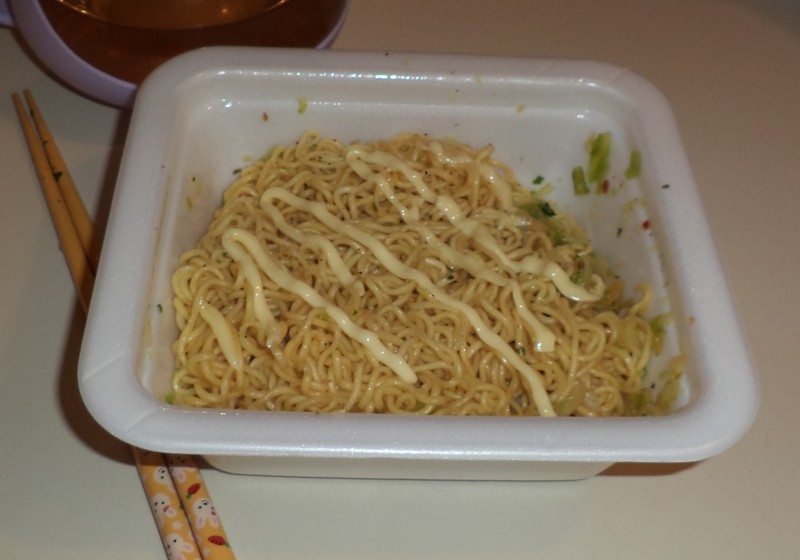
The contents of the package are roughly the same as in the other Ippeichan yakisoba, though the noodles and the sauce are both lighter in color, and the "mustard-mayonnaise" packet is instead just a "mayonnaise" packet. To prepare, we add the "Dry Vegetable" (which seems to just be dehydrated cabbage) to the container, and fill to the line with boiling water. After the noodles stand covered for three minutes, we peel open the drain spout on the other side of the container and drain the water out, then mix in the remaining packets. The "sauce" has an aroma not unlike teriyaki sauce, and then when I add the "spice" packet I notice a strong scent of black pepper. There are also sesame seeds and some unidentified red flecks along with the green seaweed powder this time. Despite what the directions say, I can't resist using the mayonnaise as a topping instead of stirring it in.
The noodles have a wonderful soft-yet-firm texture, and again Myojo has presented me with a flavor profile that is going to be difficult to describe. The sweet-and-savory note that I smelled when I opened the sauce packet is actually very subtle, and the mayo and black pepper notes are what take the forefront, with the other seasonings and hint of sweetness rounding out the flavor deliciously. If I have a criticism at all, it would be that the cabbage bits seemed to stay a bit tough, though I will also say that they seemed much less out of place here than in most of the other cabbage-wielding yakisoba varieties.
If the original Ippeichan Yakisoba is like eating a McDonald's hamburger, this one is like homemade southern-style fried chicken--it's a lighter, simpler flavor but still definitely retains the 'comfort food' feel. I honestly can't decide which one I like better, and seeing as how we're talking about one of my all-time favorite instant noodles, that is quite the compliment. Myojo has definitely crafted an excellent addition to the brand! ^_^
Tools Required: ~2 cups boiling water
620 calories per package
While it hasn't been that long since I've had a package of Myojo's Ippeichan Yakisoba to eat, it has certainly been a while since the last Myojo yakisoba review, so when I found a new variety of it to review at Uwajimaya, I was excited! But as everyone knows, finding a new food to try is less interesting than actually trying it, so for today's lunch, I am having Yomise-no Yakisoba!
The contents of the package are roughly the same as in the other Ippeichan yakisoba, though the noodles and the sauce are both lighter in color, and the "mustard-mayonnaise" packet is instead just a "mayonnaise" packet. To prepare, we add the "Dry Vegetable" (which seems to just be dehydrated cabbage) to the container, and fill to the line with boiling water. After the noodles stand covered for three minutes, we peel open the drain spout on the other side of the container and drain the water out, then mix in the remaining packets. The "sauce" has an aroma not unlike teriyaki sauce, and then when I add the "spice" packet I notice a strong scent of black pepper. There are also sesame seeds and some unidentified red flecks along with the green seaweed powder this time. Despite what the directions say, I can't resist using the mayonnaise as a topping instead of stirring it in.
The noodles have a wonderful soft-yet-firm texture, and again Myojo has presented me with a flavor profile that is going to be difficult to describe. The sweet-and-savory note that I smelled when I opened the sauce packet is actually very subtle, and the mayo and black pepper notes are what take the forefront, with the other seasonings and hint of sweetness rounding out the flavor deliciously. If I have a criticism at all, it would be that the cabbage bits seemed to stay a bit tough, though I will also say that they seemed much less out of place here than in most of the other cabbage-wielding yakisoba varieties.
If the original Ippeichan Yakisoba is like eating a McDonald's hamburger, this one is like homemade southern-style fried chicken--it's a lighter, simpler flavor but still definitely retains the 'comfort food' feel. I honestly can't decide which one I like better, and seeing as how we're talking about one of my all-time favorite instant noodles, that is quite the compliment. Myojo has definitely crafted an excellent addition to the brand! ^_^
Maruchan Midori no Tanuki Tensoba
Made by: Toyo Suisan Kaisha, Ltd. [Japan]Required to prepare: ~14oz. boiling water
460 calories per serving
Available online through Amazon.com
Last time I was at Uwajimaya, I picked up the 'sister product' to the Akai Kitsune Udon that I reviewed a few months back. Again, the name of the product is not disclosed in english, so I am left to translate the Japanese writing myself and come up with "Midori no Tanuki Tensoba", which roughly means 'green raccoon* noodles (with tempura)'. I've heard of a red fox, but I don't think I've ever seen a green raccoon. I actually imagine they are referring to the mythological kitsune and tanuki instead of the indigenous woodland creatures, though, so maybe a tanuki can be green if it wants to be.
Mythified critters aside, what we have here is an instant rendition of Japanese "Tensoba", short for tempura-soba, or buckwheat noodles topped with some fried tempura. Preparation is largely the same most other bowl noodles; we add the contents of the included packets (a powdered soup base, and what appears to be an extremely tiny amount of chili powder), fill to the line with boiling water, and cover and let stand for three minutes.
The included noodles are 'real' soba, at least to the extent that they have enough buckwheat flour in them to produce the traditional grayish color. They have an interesting bread-like mouthfeel and a deep nutty flavor. The broth is pretty much the same dashi-and-shoyu "Japanese-style" savory flavor as in the Akai Kitsune Udon, and in other "traditional" imported noodles. I happen to love the flavor, but if you didn't like it in any of the other products, this one won't be for you either. The tempura disk becomes extremely soggy, of course, which one would expect, but which Americans might not associate with the word "tempura". Unlike the abura-age from the Kitsune Udon, the tempura disk ends up breaking up into the soup instead of being eaten separately, providing nice little counterpoints of flavor throughout the dish.
While the two products--Akai Kitsune Udon and Midori no Tanuki Tensoba--have similar flavor profiles, since the broth is (as best as I can tell) exactly the same, I have to say that in the battle of Red Fox versus Green Raccoon*, I greatly prefer the Raccoon's tensoba. I think the soba noodles have an amazing flavor, and I like the way the tempura becomes a component of the dish instead of staying a separate garnish. Both are really good, naturally, but given the choice this is the one I would go back to on a regular basis. :D
*While often translated as "raccoon", the Japanese tanuki is unrelated to the true raccoon native to America and is more accurately a raccoon-dog, since the tanuki is a canine.
Wednesday, October 24, 2012
Maruchan Akai Kitsune Udon
Made By: Toyo Suisan Kaisha, Ltd. [Japan]
Required to prepare: ~14 oz. boiling water
410 calories per serving
Available online through Amazon.com
Today is a cold, rainy day in Woodinville, WA, so a hot comfort food sounds like just what I need for a quick lunch! I'm trying these noodles from Maruchan of Japan (who should not be confused with Maruchan USA). Although there is english writing on the package in various places, such as the instructions and nutrition information, strangely there is no translation of the name on the package. So, I have to resort to my extremely-limited japanese-decoding skills, and I make out the name as Akai Kitsune Udon, which seems like it would mean something like 'red fox noodles.' Whatever they're called, I'm ready to try them, so on with the review!
The kitsune [fox] part of the name means that the noodles are topped with an abura-age, which is a seasoned fried tofu pocket thing, and which are the same thing used for making inari sushi. Unlike other 'udon' products I've tried, these are dry noodles rather than being vacuum-packed fresh ones. We also have a double-packet of seasonings, that has a basic-looking soup base in one side and what seems to be an extremely tiny amount of chili powder in the other. We open the packet into the noodles, fill the bowl to the line with boiling water, close the lid, and let stand for five minutes. Then after a quick stir we are ready to eat!
The broth is mild but quite flavorful; it has that dashi flavor that I really love, like in the Nong Shim Japanese-Style Udon. I don't notice any sort of heat at all; if that really was chili powder in the packet, there wasn't enough of it to change anything. The noodles are nice, but remind me more of an egg noodle than a true udon--the flavor is close but a little too rich, and the texture isn't quite right either. Still, they are not bad by any means and accompany the broth well. The abura-age has an interesting flavor, if you've never had one; they're mildly sweet and kind of remind me of a waffle. It can also be a bit unwieldy to eat, especially (I would imagine) with a different implement than chopsticks--the outside crust is quite firm and tends to resist efforts to stab or cut it. I can fold it in half and pick it up to take bites, but I'm not sure how you'd go at it with a fork or spoon.
Overall, I liked this one quite a bit; it seemed like another nice variation on traditional Japanese noodle soup. It might not be my absolute favorite in the category, but I'll probably buy it again. :)
Required to prepare: ~14 oz. boiling water
410 calories per serving
Available online through Amazon.com
Today is a cold, rainy day in Woodinville, WA, so a hot comfort food sounds like just what I need for a quick lunch! I'm trying these noodles from Maruchan of Japan (who should not be confused with Maruchan USA). Although there is english writing on the package in various places, such as the instructions and nutrition information, strangely there is no translation of the name on the package. So, I have to resort to my extremely-limited japanese-decoding skills, and I make out the name as Akai Kitsune Udon, which seems like it would mean something like 'red fox noodles.' Whatever they're called, I'm ready to try them, so on with the review!
The kitsune [fox] part of the name means that the noodles are topped with an abura-age, which is a seasoned fried tofu pocket thing, and which are the same thing used for making inari sushi. Unlike other 'udon' products I've tried, these are dry noodles rather than being vacuum-packed fresh ones. We also have a double-packet of seasonings, that has a basic-looking soup base in one side and what seems to be an extremely tiny amount of chili powder in the other. We open the packet into the noodles, fill the bowl to the line with boiling water, close the lid, and let stand for five minutes. Then after a quick stir we are ready to eat!
The broth is mild but quite flavorful; it has that dashi flavor that I really love, like in the Nong Shim Japanese-Style Udon. I don't notice any sort of heat at all; if that really was chili powder in the packet, there wasn't enough of it to change anything. The noodles are nice, but remind me more of an egg noodle than a true udon--the flavor is close but a little too rich, and the texture isn't quite right either. Still, they are not bad by any means and accompany the broth well. The abura-age has an interesting flavor, if you've never had one; they're mildly sweet and kind of remind me of a waffle. It can also be a bit unwieldy to eat, especially (I would imagine) with a different implement than chopsticks--the outside crust is quite firm and tends to resist efforts to stab or cut it. I can fold it in half and pick it up to take bites, but I'm not sure how you'd go at it with a fork or spoon.
Overall, I liked this one quite a bit; it seemed like another nice variation on traditional Japanese noodle soup. It might not be my absolute favorite in the category, but I'll probably buy it again. :)
Monday, October 3, 2011
Nissin Sauce Yakisoba Karashi Mayonnaise Flavor
Made By: Nissin Foods (Japan)
Added Ingredients Required: Boiling Water
530 calories per package
Today, my partner is planning to have lunch out at McDonald's while she is at work, while I am spending the day at home waiting for the handyman to come by. While her motives are noble (we are suckers for the "Monopoly at McDonald's" contest) I admit I am somewhat envious. So, I did what any ramen lover would do: I searched the Noodle Stash for the most decadent thing I could find! Who needs a Big Mac when they could have a ę„ęø ć½ć¼ć¹ē¼ćć°?
Okay, so the package is completely in Japanese with no English translation anywhere outside of the Nissin logo, which means I am not 100% certain I got the product name right. I am pretty sure the flavor is "Karashi Meyone-zu," though, so based on that and the picture, I am expecting a mustard-&-mayonnaise-topped noodle similar to the Myojo Ippeichan product that I really liked.
Inside the tray, there is a block of noodles with some loose cabbage pieces floating around, and two seasoning packets--one with powdered seasoning, the other with our mayonnaise topping. The preparation seems to be the same as the Myojo product--we fill the tray with boiling water and stand for three minutes, drain out the water with the handy built-in drain spout, then remove the lid, stir in the powder seasoning, and top with the mayonnaise. It looks and smells pretty good; let's give it a try!
The noodles are a similar texture to the Myojo Ippeichan; these may be a bit softer, and they seem to clump together a lot more. The seasoning base is along the same lines too, with the smoky grilled beef and Worcestershire sauce overtones. This version seems a bit lighter in flavor, though. The mayonnaise topping was a bit less generous too, although it seems to have more karashi mustard heat. Finally, the cabbage seemed to be even more distracting here, since there were larger and more numerous pieces of it.
I definitely enjoyed this one, and it had the 'fast-food' feel that I was hoping for. Given the choice, I think the Myojo Ippeichan is the better pick of these two competing products, but if this is the only one that's available where you are, I would still heartily recommend it. :D
Added Ingredients Required: Boiling Water
530 calories per package
Today, my partner is planning to have lunch out at McDonald's while she is at work, while I am spending the day at home waiting for the handyman to come by. While her motives are noble (we are suckers for the "Monopoly at McDonald's" contest) I admit I am somewhat envious. So, I did what any ramen lover would do: I searched the Noodle Stash for the most decadent thing I could find! Who needs a Big Mac when they could have a ę„ęø ć½ć¼ć¹ē¼ćć°?
Okay, so the package is completely in Japanese with no English translation anywhere outside of the Nissin logo, which means I am not 100% certain I got the product name right. I am pretty sure the flavor is "Karashi Meyone-zu," though, so based on that and the picture, I am expecting a mustard-&-mayonnaise-topped noodle similar to the Myojo Ippeichan product that I really liked.
Inside the tray, there is a block of noodles with some loose cabbage pieces floating around, and two seasoning packets--one with powdered seasoning, the other with our mayonnaise topping. The preparation seems to be the same as the Myojo product--we fill the tray with boiling water and stand for three minutes, drain out the water with the handy built-in drain spout, then remove the lid, stir in the powder seasoning, and top with the mayonnaise. It looks and smells pretty good; let's give it a try!
The noodles are a similar texture to the Myojo Ippeichan; these may be a bit softer, and they seem to clump together a lot more. The seasoning base is along the same lines too, with the smoky grilled beef and Worcestershire sauce overtones. This version seems a bit lighter in flavor, though. The mayonnaise topping was a bit less generous too, although it seems to have more karashi mustard heat. Finally, the cabbage seemed to be even more distracting here, since there were larger and more numerous pieces of it.
I definitely enjoyed this one, and it had the 'fast-food' feel that I was hoping for. Given the choice, I think the Myojo Ippeichan is the better pick of these two competing products, but if this is the only one that's available where you are, I would still heartily recommend it. :D
Thursday, September 22, 2011
Myojo Hyoubanya no Yakisoba Japanese Noodles Sauce Flavor
Made By: Myojo Foods Co. Ltd.
Tools Required: Hot Water, utensils
500 calories per package
(available online through Amazon.com)
Today is finally another Noodle Day again! I didn't really want soup, though, so I picked this Yakisoba noodle from Myojo. I really liked the other Myojo yakisoba I tried, so I am hoping this one will be good too. The flavor on the package is only described as "Sauce Flavor," unless "Hyoubanya" is a flavor description; anyway, neither of those really help me know what sort of thing I'm about to be tasting. I aim to find out, though!
{Update 6/7/15: I've learned that Hyoubanya is in fact the brand name of the product line; the kanji that form the name would probably mean something like "food critic's seal." Also, the description of 'sauce' flavor is referring to the ubiquitous-in-Japan Bull-Dog sauce, which would be similar to (but not the same as) our worcestershire sauce or 'steak sauce.'
Inside the package are four seasoning packets, and of course our block of noodles. The packets don't shed much more light on the type of "Sauce" the flavor is going to be; the only one that has any english text on it is the "DRY VEGETABLE" packet. The other three contain a liquid sauce, a powdered soup base, and a small amount of "green laver" style seaweed mixed with something that looks like katsuo-bushi [shaved dried smoked fish]. We are supposed to add the dry veggies (mainly cabbage and onion), fill the tray with boiling water, close and let stand for three minutes, then drain with the convenient built-in drain spout before peeling the lid the rest of the way off. Finally, we add the contents of the other three packets, stir well, and serve!
As I mentioned in the review of the other Myojo yakisoba, I do love the noodle texture. I am actually sort of concerned that they will make it difficult to go back to the domestic ones. (Of course, an easy solution to that problem would be to just buy the Myojo noodles.) I'm still not going to be able to put a name to the "sauce" that these are supposed to be flavored like, but it reminds me quite a bit of the flavor of the Nong Shim Japanese-Style Udon. It is a bit smokier and spicier than those, but it has that same deep savory seafood flavor. I think in terms of ranking, I will still have to give the nod to the Ippeichan Yakisoba--although very good, these just aren't as quite as decadent--but these are pretty high up on the list too. :)
Tools Required: Hot Water, utensils
500 calories per package
(available online through Amazon.com)
Today is finally another Noodle Day again! I didn't really want soup, though, so I picked this Yakisoba noodle from Myojo. I really liked the other Myojo yakisoba I tried, so I am hoping this one will be good too. The flavor on the package is only described as "Sauce Flavor," unless "Hyoubanya" is a flavor description; anyway, neither of those really help me know what sort of thing I'm about to be tasting. I aim to find out, though!
{Update 6/7/15: I've learned that Hyoubanya is in fact the brand name of the product line; the kanji that form the name would probably mean something like "food critic's seal." Also, the description of 'sauce' flavor is referring to the ubiquitous-in-Japan Bull-Dog sauce, which would be similar to (but not the same as) our worcestershire sauce or 'steak sauce.'
Inside the package are four seasoning packets, and of course our block of noodles. The packets don't shed much more light on the type of "Sauce" the flavor is going to be; the only one that has any english text on it is the "DRY VEGETABLE" packet. The other three contain a liquid sauce, a powdered soup base, and a small amount of "green laver" style seaweed mixed with something that looks like katsuo-bushi [shaved dried smoked fish]. We are supposed to add the dry veggies (mainly cabbage and onion), fill the tray with boiling water, close and let stand for three minutes, then drain with the convenient built-in drain spout before peeling the lid the rest of the way off. Finally, we add the contents of the other three packets, stir well, and serve!
As I mentioned in the review of the other Myojo yakisoba, I do love the noodle texture. I am actually sort of concerned that they will make it difficult to go back to the domestic ones. (Of course, an easy solution to that problem would be to just buy the Myojo noodles.) I'm still not going to be able to put a name to the "sauce" that these are supposed to be flavored like, but it reminds me quite a bit of the flavor of the Nong Shim Japanese-Style Udon. It is a bit smokier and spicier than those, but it has that same deep savory seafood flavor. I think in terms of ranking, I will still have to give the nod to the Ippeichan Yakisoba--although very good, these just aren't as quite as decadent--but these are pretty high up on the list too. :)
Wednesday, September 21, 2011
Shirakiku Ramune Drink
Distributed by: Nishimoto Trading Co. (Product of Japan)
90 calories per bottle (6.76 oz.)
I've seen these Japanese soft drinks around and really never paid much attention to them; I kind of figured they were one of those "Japanophile" fad things. Uwajimaya had them on sale for $1 a bottle, though, so I figured what the heck, right? They fit the theme of the blog better than some of the
things I've reviewed.
Even before tasting any of the flavors, I have the distinct impression that the selling point is the novelty packaging and not the drink--I don't think nearly as many people would give $1-$2 for less than seven ounces of soda if it didn't come in a Codd bottle, so I'll describe and review the bottle design separately first. The bottle is sealed with a glass marble which is held against a rubber seal by the pressure in the bottle; the 'cap' on top is actually a small plunger which you use to push down on the marble, thus releasing the pressure and dropping the marble into the specially-shaped neck. It takes a surprising amount of force to shove the marble off of the seal, and if you stop pushing before you get it all the way down, the marble pops right back up to the top and you have to start over. Success is rewarded with a clinking noise and a puff of fizz as the marble is forcefully ejected into the drink. I have to admit, the marble gimmick is kind of fun, albeit in a nerdy-feeling sort of way. ^_^
Now for the actual flavors...
90 calories per bottle (6.76 oz.)
I've seen these Japanese soft drinks around and really never paid much attention to them; I kind of figured they were one of those "Japanophile" fad things. Uwajimaya had them on sale for $1 a bottle, though, so I figured what the heck, right? They fit the theme of the blog better than some of the
things I've reviewed.
Even before tasting any of the flavors, I have the distinct impression that the selling point is the novelty packaging and not the drink--I don't think nearly as many people would give $1-$2 for less than seven ounces of soda if it didn't come in a Codd bottle, so I'll describe and review the bottle design separately first. The bottle is sealed with a glass marble which is held against a rubber seal by the pressure in the bottle; the 'cap' on top is actually a small plunger which you use to push down on the marble, thus releasing the pressure and dropping the marble into the specially-shaped neck. It takes a surprising amount of force to shove the marble off of the seal, and if you stop pushing before you get it all the way down, the marble pops right back up to the top and you have to start over. Success is rewarded with a clinking noise and a puff of fizz as the marble is forcefully ejected into the drink. I have to admit, the marble gimmick is kind of fun, albeit in a nerdy-feeling sort of way. ^_^
Now for the actual flavors...
- Pineapple is very sweet and the fruit flavor is subtle; I think it probably tastes more like pineapple-flavor Life Savers than actual pineapple. :|
- Melon is fairly refreshing; still a little bit overly sweet, but not a bad rendition of a melon flavor otherwise. :)
- Grape is really average. If it were poured into a glass, I don't think I could distinguish it from a store-brand grape soda. :|
- Lychee is definitely the best of the first four I picked; it's not as syrupy as the others, and the fruit flavor is nicely well rounded, with a slight peppery finish. I really should find a lychee fruit to sample one of these days so I can compare, but I definitely enjoyed this one. :)
Friday, September 2, 2011
Roxy Crab Chips
Distributed by Roxy Trading Inc. (Product of Japan)
140 calories per 1 oz. serving
Usually when I get to an asian grocery to shop for noodles, I also end up bringing home a few imported snacks and things that I can't buy locally, for novelty and variety. These Crab Chips caught my eye, I think mainly because of the coloring of the chips; they are stark white (probably even whiter in person than the picture makes it look) with little red flecks, presumably to suggest the appearance of crab meat.
Unfortunately, the appearance is the only thing that is suggestive of crab meat--there is absolutely no detectable crab or seafood flavor whatsoever. The flavor did seem familiar though, and it actually took me most of the way through one serving to figure out what they taste like. So here it is: They taste like fried wonton sheet. You know, like those little crispy strips they give you at chinese restaurants to put in your egg drop soup? That's just what this tastes like. So if you happen to want a whole bag of those, except shaped like little discs and decorated like crab for some reason, you are in luck if you find a bag of these. Otherwise, I tried them for you so you don't have to. :\
140 calories per 1 oz. serving
Usually when I get to an asian grocery to shop for noodles, I also end up bringing home a few imported snacks and things that I can't buy locally, for novelty and variety. These Crab Chips caught my eye, I think mainly because of the coloring of the chips; they are stark white (probably even whiter in person than the picture makes it look) with little red flecks, presumably to suggest the appearance of crab meat.
Unfortunately, the appearance is the only thing that is suggestive of crab meat--there is absolutely no detectable crab or seafood flavor whatsoever. The flavor did seem familiar though, and it actually took me most of the way through one serving to figure out what they taste like. So here it is: They taste like fried wonton sheet. You know, like those little crispy strips they give you at chinese restaurants to put in your egg drop soup? That's just what this tastes like. So if you happen to want a whole bag of those, except shaped like little discs and decorated like crab for some reason, you are in luck if you find a bag of these. Otherwise, I tried them for you so you don't have to. :\
Thursday, September 1, 2011
Myojo Ippeichan Yomise-no Yakisoba
Made By: Myojo Foods Co. Ltd. (Japan)
Tools Required: Hot Water, utensils
610 calories per package
(available online through Amazon.com
)
Where yesterday's noodle packaging seemed to want to imply a traditional dish, today I am choosing this one that looks like it wants to be more of a modern diner or "fast food" fare; the garishly colored package depicts condiment bottles and what looks to be a sleeve of french fries. This one looks like it's going to be a lot of fun, so let's get right into it!
There is a block of dark colored noodles, and a wide assortment of flavor packets: one with dried vegetables, a liquid sauce and powdered 'spice', and one which is colorfully labelled Mustard Mayonnaise. Unlike all domestic Yakisoba or Chow Mein, rather than using our microwave, these use a hot water preparation; we add the dried vegetables and fill the tray with boiling water, wait three minutes, and then peel off the tab on the drain spout and drain the noodles from the corner that is still sealed. The design works remarkably well! I was able to drain virtually all of the water, and the lid stayed very securely attached. After draining, we are supposed to add the sauce, which sort of smells like steak sauce, and the spice powder, which turns out to be a deep green color, stir them in, and then top with the mustard-mayo. The finished product turns out to be very fun-looking and the aroma kind of reminds me of sitting in a McDonalds. This should be interesting!
The noodle texture is wonderful! They are very soft and tender, and separate easily without much clumping. The flavor almost defies description, honestly... between the mayonnaise and mustard flavor of the topping, the tartness of the sauce (which according to the ingredients panel was mostly Worcestershire sauce), and the savory spice flavors, it really does seem like the noodle version of eating a nice juicy burger. The only thing that seems even slightly out of place are the cabbage bits from the veggie packet, but they don't really detract either.
These are incredibly delicious, and in an insidiously addictive way--I am already wishing I could have some more. I predict that I will be grabbing several of these each time I go to the asian grocery, and I could even see myself making a special trip if I got to craving them. They feel like a guilty pleasure, but with emphasis on the word pleasure. More, please! ^_^
Tools Required: Hot Water, utensils
610 calories per package
(available online through Amazon.com
Where yesterday's noodle packaging seemed to want to imply a traditional dish, today I am choosing this one that looks like it wants to be more of a modern diner or "fast food" fare; the garishly colored package depicts condiment bottles and what looks to be a sleeve of french fries. This one looks like it's going to be a lot of fun, so let's get right into it!
There is a block of dark colored noodles, and a wide assortment of flavor packets: one with dried vegetables, a liquid sauce and powdered 'spice', and one which is colorfully labelled Mustard Mayonnaise. Unlike all domestic Yakisoba or Chow Mein, rather than using our microwave, these use a hot water preparation; we add the dried vegetables and fill the tray with boiling water, wait three minutes, and then peel off the tab on the drain spout and drain the noodles from the corner that is still sealed. The design works remarkably well! I was able to drain virtually all of the water, and the lid stayed very securely attached. After draining, we are supposed to add the sauce, which sort of smells like steak sauce, and the spice powder, which turns out to be a deep green color, stir them in, and then top with the mustard-mayo. The finished product turns out to be very fun-looking and the aroma kind of reminds me of sitting in a McDonalds. This should be interesting!
The noodle texture is wonderful! They are very soft and tender, and separate easily without much clumping. The flavor almost defies description, honestly... between the mayonnaise and mustard flavor of the topping, the tartness of the sauce (which according to the ingredients panel was mostly Worcestershire sauce), and the savory spice flavors, it really does seem like the noodle version of eating a nice juicy burger. The only thing that seems even slightly out of place are the cabbage bits from the veggie packet, but they don't really detract either.
These are incredibly delicious, and in an insidiously addictive way--I am already wishing I could have some more. I predict that I will be grabbing several of these each time I go to the asian grocery, and I could even see myself making a special trip if I got to craving them. They feel like a guilty pleasure, but with emphasis on the word pleasure. More, please! ^_^
Subscribe to:
Posts (Atom)